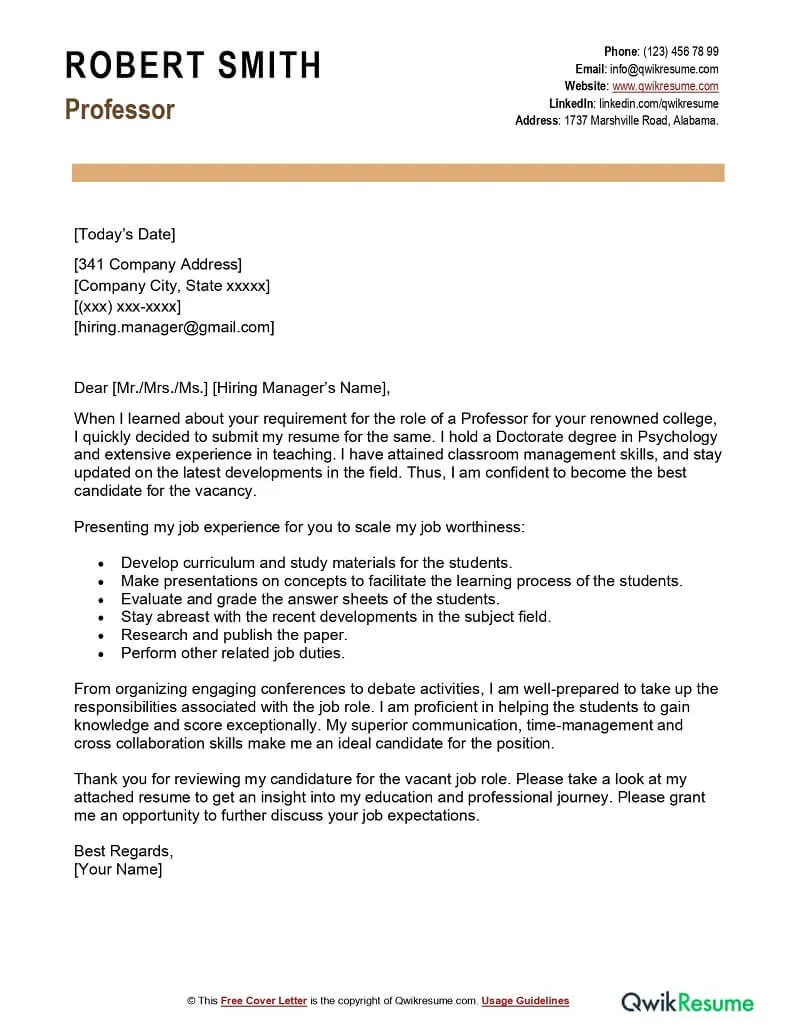
Understanding the Assistant Professor Cover Letter
An assistant professor cover letter is a crucial document in your job application, serving as your introduction to the hiring committee. It complements your curriculum vitae (CV) and provides an opportunity to highlight your qualifications, experiences, and suitability for the position. Unlike a resume, which offers a brief overview, a cover letter allows you to elaborate on your skills, explain your research interests, and demonstrate your passion for teaching and scholarship. Crafting a compelling cover letter can significantly increase your chances of landing an interview and ultimately securing the job. This document is not merely a formality; it’s a strategic tool to showcase your unique value proposition and persuade the committee that you are the ideal candidate. A well-written cover letter can make you stand out from a pool of applicants.
What is the Purpose of a Cover Letter
The primary purpose of an assistant professor cover letter is to persuade the hiring committee that you are the best fit for the role. It serves as your initial opportunity to make a positive impression and demonstrate your understanding of the position’s requirements. A well-crafted letter achieves several key objectives. First, it introduces you and your expertise, providing a narrative that complements your CV. Second, it showcases your alignment with the university’s mission, values, and specific departmental needs. Third, it highlights your most relevant accomplishments, research contributions, and teaching experiences. Finally, it articulates your enthusiasm for the opportunity and your vision for your future contributions to the institution. Effectively, the cover letter is your chance to tell a story, connecting your skills and experiences with the needs of the hiring committee, making them eager to learn more about you.
Key Components of a Cover Letter

A successful assistant professor cover letter incorporates several essential components, each playing a vital role in making your case. Begin with a clear and professional contact information section, followed by a formal salutation addressed to the appropriate hiring committee member or department head. The introductory paragraph should immediately capture the reader’s attention by stating the position you are applying for and briefly summarizing your key qualifications. The body paragraphs should then provide detailed examples of your research, teaching, and service experiences, demonstrating how your skills align with the job requirements. Tailor each paragraph to the specific needs of the position and university. Include specific examples of how you have contributed to previous institutions and what you plan to bring to the new role. The closing paragraph should reiterate your interest, express gratitude, and include a call to action, such as inviting them to review your attached CV or requesting an interview.
Formatting Your Cover Letter
Proper formatting is crucial for creating a professional and readable cover letter. Start by choosing a standard, easy-to-read font such as Times New Roman, Arial, or Calibri, with a font size between 10 and 12 points. Use single-spaced lines within paragraphs and double-spaced lines between paragraphs to enhance readability. Maintain consistent margins (typically 1 inch on all sides) throughout the document. Structure your letter with clear sections and headings to guide the reader. The layout should be clean and uncluttered, allowing the content to speak for itself. Use bullet points or numbered lists to highlight key accomplishments or skills. Ensure that your formatting is consistent throughout the document, and use a professional-looking template if desired. A well-formatted cover letter demonstrates attention to detail and professionalism, making a positive first impression on the hiring committee. Proper formatting significantly enhances the readability of your application.
Contact Information and Date
Begin your cover letter with your contact information at the top. This should include your full name, address, phone number, and professional email address. Ensure the email address is professional and appropriate for the application. Following your contact information, include the date you are submitting the application. Ensure that the date format is consistent with the standards of the country where you are applying. This information should be clearly presented, allowing the hiring committee to easily contact you if needed. Accuracy and professionalism in this section are essential, as it sets the tone for the rest of the letter. Always double-check for errors to avoid any miscommunication.
The Salutation

The salutation is your initial greeting, and it should be professional and tailored to the recipient. The most formal approach is to address the letter to a specific person, such as the hiring committee chair or the department head. If a name is available, use “Dear Dr. [Last Name]” or “Dear Professor [Last Name]”. If the name of the contact person is not available, use a general salutation, such as “Dear Hiring Committee” or “Dear Search Committee”. Avoid generic salutations like “To Whom It May Concern,” as they can make your letter seem impersonal. Research the department’s website or job posting to identify the appropriate contact person. Using the correct salutation demonstrates your attention to detail and respect for the hiring process, making it more likely to be received favorably.
Crafting the Introductory Paragraph
The introductory paragraph is your first opportunity to capture the reader’s attention and state your purpose. Clearly state the position you are applying for, and where you found the job posting. Include a brief and compelling summary of your key qualifications, experiences, and how they align with the requirements of the position. Mention any unique skills or experiences that make you stand out from other applicants. Express your enthusiasm for the opportunity and the institution. The goal of this paragraph is to immediately engage the reader and make them want to read the rest of your letter. It should be concise, impactful, and highlight your most relevant strengths. A strong introduction will significantly increase the likelihood of a positive response from the hiring committee. This is your initial pitch, so make it count.
Highlighting Your Qualifications
The body paragraphs of your cover letter should provide detailed examples of your qualifications, research, and teaching experience. Clearly demonstrate how your skills, knowledge, and achievements align with the specific requirements listed in the job description. Use concrete examples and quantifiable results whenever possible. If the job description emphasizes research, discuss your publications, grants, and presentations, highlighting your research interests and their relevance to the department’s focus. If the position requires teaching experience, detail the courses you have taught, your teaching philosophy, and any positive student evaluations or awards. Include any relevant service experience, such as committee memberships or community outreach initiatives. Tailor your letter to the specific requirements of each position, and provide evidence to support your claims, showcasing how you can contribute to the department’s overall goals.
Showcasing Research Experience

When showcasing your research experience, be specific and provide details that demonstrate your accomplishments. Mention your publications in peer-reviewed journals, books, or conference proceedings. Quantify your impact by citing the number of publications, citations, or research grants received. Clearly articulate your research interests and how they align with the department’s current research focus. Highlight any collaborative research projects and your role within these teams. Include details about the methodologies you employ, the research questions you address, and the significance of your findings. Mention any awards or recognition you have received for your research. The goal is to present a clear picture of your research trajectory, expertise, and potential contributions to the department’s research landscape. Be precise, informative, and demonstrate the value and relevance of your research.
Demonstrating Teaching Skills
Demonstrating your teaching skills is equally important. Describe the courses you have taught, including the course levels, subjects, and your role in curriculum development. Detail your teaching philosophy and how it informs your approach to student learning. Mention any innovative teaching methods or technologies you employ, such as online learning platforms or experiential learning activities. Provide examples of how you engage students, foster critical thinking, and promote a positive learning environment. Highlight positive student evaluations, awards for teaching excellence, or any feedback you have received. If you have mentored students, mention their achievements. Your goal is to portray yourself as an effective and dedicated educator who is passionate about student success. Include concrete examples and highlight how your teaching skills will benefit the department and its students.
Addressing the Specific Job Requirements
Carefully review the job description and address each of the specific requirements outlined. Tailor your cover letter to reflect the key qualifications, skills, and experiences that the hiring committee is looking for. Use the same keywords and terminology from the job description to demonstrate that you understand the needs of the position. Provide evidence to support your claims, such as specific projects, publications, or teaching accomplishments. Explain how your skills and experiences align with the departmental needs and how you can contribute to its goals. If the job description emphasizes certain research areas or teaching methods, highlight your relevant experiences. Ensure that your cover letter directly addresses the requirements of the position. Demonstrating this alignment helps the hiring committee see you as a good fit for the role and increases your chances of being selected for an interview. This approach demonstrates that you have carefully considered the role and its expectations.
Tailoring to the University’s Culture

Research the university and department to understand their mission, values, and culture. Customize your cover letter to demonstrate your understanding of their specific needs and priorities. Highlight how your research interests, teaching philosophy, and service experience align with the university’s goals. Mention specific faculty members whose work resonates with yours, showing that you have invested time in understanding the department’s strengths. If the university emphasizes diversity, equity, and inclusion, incorporate this in your letter by discussing your commitment to creating an inclusive learning environment. Show your enthusiasm for the university and the opportunities it offers. Demonstrating this cultural fit showcases that you are a candidate who is likely to thrive in the department and contribute positively to its community. Your research and understanding of the university can set you apart from other candidates.
Writing a Compelling Closing
The closing paragraph of your cover letter should reiterate your interest in the position and express your gratitude for the hiring committee’s consideration. Reiterate your key qualifications and why you believe you are a good fit for the role. State your enthusiasm for the opportunity and the prospect of contributing to the department and university. Express your willingness to discuss your application further. Include a clear call to action, such as inviting the hiring committee to review your attached CV or requesting an interview. Be confident and professional in your closing. Thank the committee for their time and consideration. A strong closing leaves a lasting positive impression, increasing the likelihood of a positive response from the hiring committee and making them eager to consider your application further. This is your final opportunity to leave a lasting impression.
Proofreading and Editing
Before submitting your cover letter, carefully proofread and edit it to ensure that it is free of errors. Check for grammatical errors, spelling mistakes, and punctuation errors. Review the letter for clarity, conciseness, and coherence. Ensure that your writing style is professional and appropriate for the context. It’s helpful to have a colleague, mentor, or career advisor review your cover letter as well, as they may catch errors that you have missed. Pay close attention to the details, as small errors can undermine your credibility. The cover letter should reflect your professional communication skills and attention to detail. A well-proofread and edited cover letter demonstrates your commitment to excellence. Use grammar checkers, but remember that they cannot catch every error, so human review is essential. Thorough proofreading is an investment in your professional image.
Formatting and Presentation

The formatting and presentation of your cover letter are as important as its content. Use a professional-looking font, such as Times New Roman or Arial, and ensure that the font size is between 10 and 12 points. Maintain consistent margins (typically 1 inch on all sides) throughout the document. Use single-spaced lines within paragraphs and double-spaced lines between paragraphs to improve readability. Ensure that your letter is easy to read. Use clear sections and headings to guide the reader. Use bullet points or numbered lists to highlight key accomplishments or skills. The overall look should be clean and uncluttered. Present your letter on high-quality paper, if submitting a hard copy. The formatting and presentation should reflect your professionalism and attention to detail. A well-formatted cover letter shows that you are serious about the application. This is your chance to make a strong first impression. A well-formatted and presented cover letter will enhance your chances.
Tips for Success
To increase your chances of landing an assistant professor position, follow these additional tips. Tailor each cover letter to the specific job and university, highlighting your relevant experience and skills. Research the university and department thoroughly, showing that you understand their mission and goals. Quantify your accomplishments whenever possible, providing specific examples and data. Proofread your letter carefully, and have someone else review it. Be enthusiastic and demonstrate your passion for teaching, research, and the opportunity. Follow up with the hiring committee after submitting your application. Prepare for your interview by anticipating common questions and practicing your responses. Showcase your alignment with the university’s culture. By following these tips, you can create a compelling cover letter that highlights your qualifications and increases your chances of securing the job.