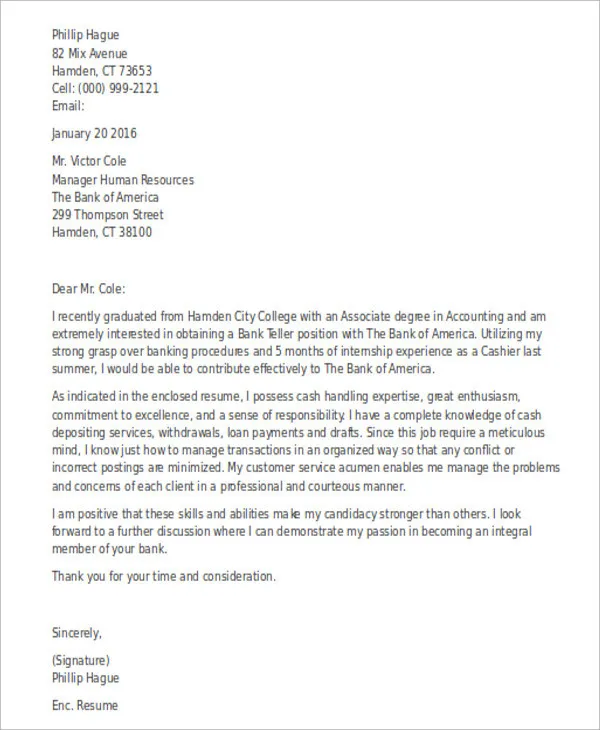
Why a Bank Teller Cover Letter Is Crucial
In the competitive world of job applications, particularly for roles like bank tellers where experience is often a primary requirement, a cover letter becomes your essential tool. It’s your first and sometimes only opportunity to make a strong impression, demonstrating your enthusiasm, and highlighting your suitability for the role even when you lack direct experience. A well-crafted cover letter allows you to go beyond the confines of your resume, offering a glimpse into your personality, and explaining how your skills align with the bank’s needs. It’s your chance to narrate your story, showcasing your unique value proposition and setting you apart from other applicants. Without a compelling cover letter, your resume may get lost in the sea of applications, making it an indispensable element in your job search strategy. Ignoring the importance of a cover letter is a critical mistake, effectively minimizing your chances of landing an interview and securing your desired position as a bank teller.
Highlighting Transferable Skills Without Experience
When you don’t have direct experience as a bank teller, focusing on your transferable skills becomes your key strategy. These are the skills you’ve developed in other roles, educational settings, or life experiences that are relevant to the bank teller position. For instance, if you’ve worked in retail, you can highlight your customer service skills. If you were involved in clubs or volunteer work, you can draw on your experience with teamwork or leadership. Identifying and articulating these skills helps bridge the gap created by your lack of experience, providing the hiring manager with an understanding of your potential. It allows you to demonstrate that while you may not have held the specific job title before, you possess the core competencies necessary for success. The more effectively you can identify and communicate these transferable skills, the more compelling your application will become, increasing your chances of moving forward in the hiring process. Think carefully about every experience you have and what skills you gained.
Customer Service Experience

Customer service is a cornerstone of the bank teller role. Even without direct banking experience, you can showcase your customer service skills by providing examples from previous jobs, volunteer work, or even personal interactions. Did you work in retail? Mention your ability to handle customer inquiries and resolve issues. Did you volunteer at a non-profit? Describe how you assisted people with their needs. Highlight your patience, empathy, and ability to create positive experiences. Demonstrate your capacity to actively listen, understand customer needs, and provide solutions. Explain how you go above and beyond to exceed customer expectations, as this is often more valuable than the experience itself. It’s about proving that you can build rapport, handle difficult situations, and consistently represent the bank in a professional and helpful manner. Focus on specific instances where your customer service skills made a difference. Make sure to explain how you handled a particularly difficult customer, and what you learned from it.
Communication Skills
Strong communication skills are indispensable for bank tellers. You must be able to communicate clearly and concisely, both verbally and in writing, to interact effectively with customers and colleagues. Provide examples from your past where you successfully conveyed information or instructions, resolved misunderstandings, or adapted your communication style to different audiences. If you’ve ever given a presentation, led a team discussion, or simply explained a complex topic to someone, highlight those instances. Emphasize your ability to listen attentively, ask clarifying questions, and ensure mutual understanding. Mention your ability to remain calm and composed under pressure. Show how you can explain financial products and services, and provide a top-notch customer experience. Illustrate instances where you successfully navigated difficult conversations or handled complaints, demonstrating your ability to remain professional and solution-oriented. Remember, effective communication fosters trust and builds strong customer relationships.
Problem-Solving Skills
Bank tellers encounter a variety of problems daily, so your ability to think critically and solve problems is extremely valuable. Think of instances in your past where you had to analyze a situation, identify issues, and find solutions. Did you troubleshoot a technical issue at work? Did you resolve a dispute within a team? Explain the steps you took to solve the problem, emphasizing your analytical skills, your ability to think outside the box, and your persistence in finding a resolution. Outline how you gather information, evaluate options, and make sound decisions. Showcase your resourcefulness by illustrating how you use available resources, seek help when necessary, and learn from your mistakes. Detail how you approach complex situations, breaking them down into manageable components and finding effective solutions, which will impress the hiring manager.
Attention to Detail

Accuracy is critical in banking. Demonstrating your attention to detail can significantly boost your application. Provide examples from your past that showcase your ability to be precise and accurate. Did you work in a role where you handled paperwork or data entry? Describe how you ensured accuracy and minimized errors. Did you organize or manage complex projects? Highlight how you paid attention to every aspect. Share specific instances where you caught an error, followed instructions meticulously, or implemented a process to maintain accuracy. Mention any experience you have with proofreading or reviewing documents, and emphasize your commitment to minimizing mistakes. Your ability to maintain a high level of accuracy in a fast-paced environment is crucial, so show that you possess this ability. Mention any training you might have undertaken to improve your attention to detail.
Emphasizing Your Passion and Enthusiasm
One of the most effective ways to compensate for a lack of experience is to showcase your passion for the role and your enthusiasm for the bank. Express your genuine interest in the banking industry and what specifically attracts you to the bank teller position. Clearly state why you want to work at that particular bank; it shows you’ve done your research. Mention any personal experiences that have piqued your interest in banking. Share how you enjoy working with people, helping them achieve their financial goals, or being part of a trusted institution. Communicate how excited you are about the opportunity to learn and grow within the company. Your passion and enthusiasm can often outweigh a lack of experience, as they show your willingness to learn, your dedication, and your commitment to the role. Use your cover letter to convey your excitement, which will leave a positive impression.
Researching the Bank and Tailoring Your Letter
A generic cover letter won’t impress anyone. To make your application stand out, you must conduct thorough research on the bank and tailor your cover letter accordingly. Visit the bank’s website, read about their mission, values, and recent achievements. Identify their products and services, and consider what differentiates them from competitors. Learn about their culture and any specific initiatives they’re involved in, such as community outreach or employee development programs. Then, customize your cover letter to reflect your understanding of the bank, using the information you’ve gathered to highlight how your skills and experiences align with their needs. Mention specific values or initiatives that resonate with you, and express how you can contribute to their goals. Tailoring your cover letter shows that you are invested in the position and are willing to invest time and effort in learning more about the company. This level of detail will impress the hiring manager and make your application more compelling. Make sure to personalize it for the specific bank, and the specific role you are applying for.
Demonstrating Knowledge of Bank Teller Responsibilities

Even without prior experience, you can demonstrate your understanding of the bank teller responsibilities. Research the day-to-day tasks, such as processing transactions, assisting customers with inquiries, balancing cash drawers, and promoting bank products and services. In your cover letter, briefly mention the responsibilities you understand and express your willingness to learn the specifics. Convey your knowledge of the importance of accuracy, confidentiality, and customer service. Highlight any transferable skills that align with these responsibilities. Express your understanding of the need to follow established policies and procedures. Mention any relevant training or coursework that has prepared you for these tasks. Demonstrate your understanding of the role’s demands and your preparedness to succeed, even with minimal experience. This shows the hiring manager that you have a good understanding of the job, and what will be expected of you.
Drafting a Strong Opening
The opening paragraph of your cover letter is your first, and often most important, opportunity to capture the hiring manager’s attention. It should be concise, engaging, and immediately indicate why you are writing. Clearly state the position you are applying for and where you saw the advertisement. Express your enthusiasm for the role and the bank. Briefly mention a key transferable skill or a relevant experience that aligns with the job requirements. Show your understanding of the bank’s mission and values. Avoid generic statements. Instead, personalize your opening by mentioning something specific that caught your eye. Your goal is to immediately show that you are a great fit for the position. Use a compelling opening that will make the hiring manager want to read more about you. Mention anything that makes you stand out from the crowd.
Crafting the Body of Your Cover Letter
The body of your cover letter is where you provide evidence of your skills and qualifications. Break down your body into well-structured paragraphs. Begin by discussing the main requirements of the bank teller role, and demonstrate how your skills and experiences align with those requirements. Provide specific examples of your achievements from previous experiences. Don’t just list your skills; instead, illustrate how you’ve applied them in real-world situations. Use the STAR method (Situation, Task, Action, Result) to detail your examples, emphasizing the positive outcomes you achieved. The body should showcase your personality and convey your enthusiasm for the position. Highlight your passion for customer service, your attention to detail, your communication skills, and your willingness to learn. Use action verbs to describe your achievements. Remember, the goal is to convince the hiring manager that you’re the best candidate for the job, despite your lack of direct experience.
Showcasing Your Skills and Qualities

Focusing on your skills and qualities is crucial in your cover letter, especially when you lack direct experience. Tailor your skills to align with the bank teller requirements. Highlight your customer service skills, communication abilities, problem-solving skills, and attention to detail. Provide concrete examples that showcase these qualities. Quantify your achievements whenever possible to demonstrate impact and effectiveness. For example, instead of saying ‘Improved customer satisfaction,’ you can say, ‘Improved customer satisfaction by 15% by implementing a new customer service protocol.’ Show, don’t just tell, about your attributes. Use strong verbs and avoid vague language. Demonstrate your ability to be accurate and efficient. The goal is to make it easy for the hiring manager to recognize how your skills and qualities make you a good fit for the role. Show that you have the ability to take on a customer’s problem and resolve it effectively, and quickly.
Writing a Compelling Closing Statement
The closing statement is your last chance to make a positive impression. Restate your interest in the position and reiterate your enthusiasm for the bank. Summarize how your skills and experiences make you a strong candidate, even without direct experience. Express your eagerness to learn and grow within the company. Clearly state your availability for an interview and include your contact information. Thank the hiring manager for their time and consideration. Keep the closing concise, confident, and professional. Proofread your closing statement carefully to ensure there are no errors. Avoid overly generic or cliché phrases. End your letter with a strong, positive statement that leaves a lasting impression. Consider including a call to action, such as ‘I look forward to the opportunity to discuss my qualifications further in an interview.’
Formatting Your Cover Letter for Maximum Impact
Formatting is often overlooked, but it’s an important aspect of your cover letter. Choose a professional font such as Times New Roman, Arial, or Calibri, and use a font size between 10 and 12 points. Keep the letter to one page. Use a clear and easy-to-read format. Ensure there is consistent spacing, and use bullet points or lists to highlight key information. Proofread the letter carefully to eliminate spelling and grammatical errors. Use a professional layout with appropriate margins and spacing. The appearance of your cover letter communicates attention to detail and professionalism. Organize the letter with clear sections, such as your opening, body, and closing statements. Make sure the letter looks clean and well-organized. Avoid unnecessary graphics, and make the letter easy to read. Maintain a professional tone throughout the letter. A well-formatted letter makes it easy for the hiring manager to read and appreciate your key qualifications.
Proofreading and Editing Your Cover Letter

Proofreading and editing are critical steps in the cover letter writing process. A single spelling or grammatical error can undermine your credibility. Proofread your cover letter several times. Read it aloud to catch any awkward phrasing or errors. Ask a friend or family member to review it for you. Ensure your language is clear, concise, and professional. Check that your formatting is consistent. Verify all the names, dates, and titles. Make sure the letter aligns with the job description and emphasizes the key requirements. The more carefully you proofread and edit your cover letter, the more polished it will be. Proofreading shows that you are careful, detailed, and committed to quality. A well-proofread cover letter increases your chances of making a positive impression and securing an interview. Make sure you check for proper grammar, spelling, and punctuation before submitting your letter.