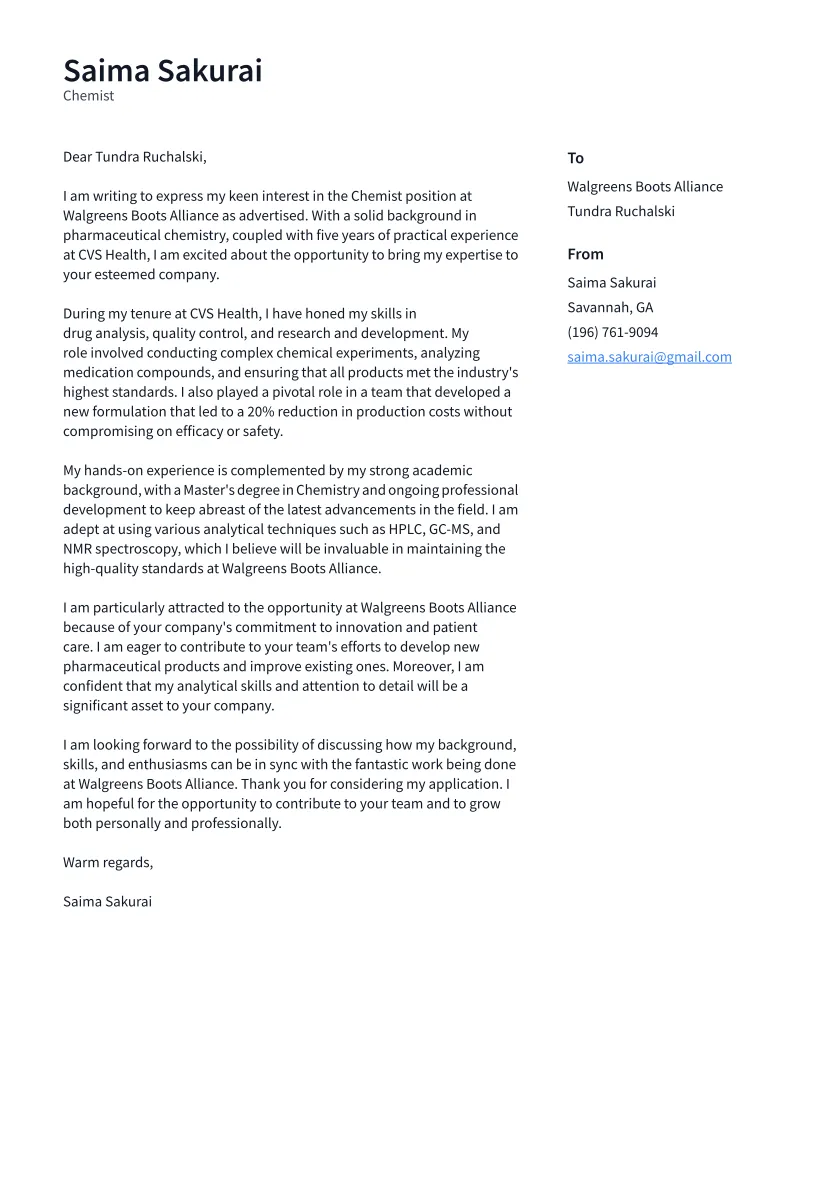
The Importance of a Chemist Cover Letter
A well-crafted chemist cover letter is your first opportunity to make a strong impression on a potential employer. It’s more than just a formality; it’s a crucial tool that allows you to showcase your skills, experience, and personality in a way that a resume alone cannot. This document provides context to your application, explaining why you’re the perfect fit for the specific role and the company. It helps you stand out from other candidates by highlighting your unique qualifications and demonstrating your genuine interest in the position. A compelling cover letter can significantly increase your chances of landing an interview, making it an essential component of any successful job application in the field of chemistry. Consider this your chance to tell your story and sell yourself effectively.
Highlighting Your Skills
Your cover letter should act as a spotlight, illuminating the skills most relevant to the chemist position you’re applying for. Don’t simply list your abilities; provide specific examples of how you’ve utilized these skills in past roles. This section is where you demonstrate your suitability for the job, so tailor it to match the requirements outlined in the job description. For instance, if the job emphasizes analytical chemistry, focus on your experience with specific analytical techniques and instruments. If the role involves research and development, emphasize your research experience, publications, and contributions to projects. The goal is to make it clear that your skills align perfectly with what the employer is seeking. This can be shown by explaining your expertise, what you did and the results.
Technical Proficiency

Technical skills are the backbone of a chemist’s abilities, so be sure to highlight your proficiency with relevant laboratory equipment, software, and methodologies. Mention specific instruments you have experience with, such as GC-MS, HPLC, NMR, or other specialized tools. Detail any software programs you’re familiar with, like data analysis software, modeling software, or laboratory information management systems (LIMS). Specify your expertise in methodologies like synthesis, purification, analysis, or any other relevant techniques. Be specific about your level of experience – whether you’re a seasoned expert or have some familiarity. Emphasizing these technical skills shows your ability to quickly contribute to the laboratory and make it clear that you can handle the demands of the role.
Laboratory Experience
Detailing your laboratory experience is critical. Briefly describe the types of laboratories you’ve worked in, such as research labs, quality control labs, or pharmaceutical labs. Provide context about the projects you’ve contributed to, the type of samples you worked with, and the experiments you performed. Be sure to mention any experience with laboratory safety protocols, including your ability to handle chemicals and operate equipment safely. If you have any specific certifications or training related to laboratory safety, include them in your application. Show that you are a dependable and experienced lab worker by showcasing your understanding and previous experience. Highlighting your lab experience gives the hiring manager confidence in your ability to step in and be productive from day one.
Analytical Skills
Analytical skills are central to the role of a chemist, and your cover letter needs to reflect your proficiency in this area. Elaborate on your experience with various analytical techniques, such as spectroscopy, chromatography, or titration. Provide examples of how you’ve used these techniques to solve problems, interpret data, and draw conclusions. Mention any experience with statistical analysis, data interpretation, or quality control procedures. Highlight your ability to troubleshoot equipment and identify any problems. Showcase your ability to approach tasks with precision and a critical mindset and demonstrate how you have used those skills to ensure the accuracy and validity of the collected data. Remember that your analytical skills are essential to a chemist, so make sure to properly emphasize them.
Showcasing Relevant Experience

Your cover letter is the perfect place to provide a snapshot of your experience. Align your description of the experiences with the job requirements. Include details about previous roles, the industries you’ve worked in, and the projects you contributed to. Focus on the specific accomplishments and responsibilities that align with the job you are applying for. If the job description calls for experience with a specific chemical process, emphasize your experience with that process. Use action verbs to describe what you did, and quantify your achievements whenever possible. This will help the recruiter and/or hiring manager quickly understand your suitability. In other words, present your experience as the solution to the problems and needs of the hiring company.
Project Management
If you’ve had experience managing projects, be sure to showcase those skills in your cover letter. Describe the size and scope of the projects you’ve managed, and your responsibilities. Provide specific examples of the projects you have been in charge of, including your goals, the project scope and the methods you used. Showcase your experience with planning experiments, managing resources, meeting deadlines, and leading teams. Highlight any successes you achieved through project management, such as improvements in efficiency, cost savings, or successful project completions. These are the type of achievements that will surely catch the attention of a potential employer.
Research Experience
If your job requires some research, make sure that you describe your research experience in detail. Explain the nature of the research, the methodologies you used, and the contributions you made to the research. Specify the research areas, the projects you worked on, and the results you achieved. Highlight any publications, presentations, or awards you have received. Show your passion for research and your ability to work independently and as part of a team. Make sure your cover letter reflects your research accomplishments because it is essential to impress the hiring manager. This will help them see you as a capable and experienced professional.
Communication Skills

Chemists often need to communicate complex information clearly and concisely, so make sure to highlight your communication skills. Provide examples of your experience writing reports, presenting research findings, and explaining complex chemical concepts to a non-technical audience. Describe how you communicate with team members, supervisors, and other stakeholders. Highlight your ability to communicate complex information simply and clearly, and your skill at explaining scientific concepts to people who don’t have a scientific background. Make sure that you show confidence and confidence in your ability to communicate. These skills are essential in the field of chemistry, where you will be expected to be able to explain and defend your position on matters of the profession.
Writing and Reporting
Writing skills are essential, so ensure you demonstrate your ability to write clear, concise, and accurate reports and other documents. Provide examples of reports you have written, the type of information you included, and the audience you were writing for. Describe your experience with documenting experiments, writing research papers, and preparing presentations. Emphasize your ability to organize information logically, use proper grammar and formatting, and present data effectively. Make sure you highlight that you can translate complex data into clear and understandable written form. This will demonstrate your skills and highlight your ability to share your work.
Teamwork and Collaboration
Highlighting your ability to work collaboratively is essential, as most chemistry roles require teamwork. Describe the types of teams you have worked with, your role within those teams, and the contributions you made. Provide examples of how you’ve worked effectively with others to achieve common goals. Demonstrate your ability to communicate effectively, resolve conflicts, and share knowledge. Show that you know how to work with colleagues from different backgrounds. If you have specific examples of how you’ve improved team performance or resolved conflicts, include those in your cover letter. This is an essential skill to show that you can coordinate with your peers. Your teamwork and collaboration skills demonstrate that you are a good fit.
Formatting Your Chemist Cover Letter

The formatting of your chemist cover letter is just as important as its content. Pay close attention to the layout, font, and overall presentation. A well-formatted cover letter is easier to read and demonstrates your attention to detail. This section will help ensure that you are presenting your best foot forward. Make sure that you format your letter so that it is a perfect fit for what is asked of you.
Contact Information
Begin your cover letter with your contact information, including your full name, phone number, email address, and LinkedIn profile URL. Make sure your contact information is easy to find and up-to-date. Place this information at the top of the letter, typically on the left side. Use a professional-looking email address. If the job posting specifies a particular way to submit your application, be sure to follow those instructions closely. Your contact information is the first thing a hiring manager will see, so make a good impression and make it easy to reach you. This is an essential step in the job application process, so take your time to properly address this section.
The Opening Paragraph
The opening paragraph is your chance to grab the reader’s attention. State the position you are applying for, where you found the job posting, and why you are interested in the role. If you are applying for a specific job, mention it by name. Briefly highlight your key qualifications and skills, and express your enthusiasm for the opportunity. Tailor this paragraph to each job application, showing that you understand the company’s needs and your ability to meet them. This should be short, concise, and compelling. Make the hiring manager want to read more. A strong opening paragraph will set the tone for the rest of your cover letter, so be sure to make it count.
Body Paragraphs Highlighting Achievements

The body paragraphs are where you go into detail about your experience, skills, and achievements. Use these paragraphs to showcase your key qualifications. Focus on the most relevant skills and experiences, providing specific examples to support your claims. Use a clear and concise writing style, and avoid jargon or technical terms. Use bullet points or numbered lists to make your points easier to read. Quantify your achievements whenever possible, using data and metrics to demonstrate your impact. Ensure that you provide an in-depth account of how you have used your experience and abilities to contribute to prior projects and roles. Focus on achievements and results. This will help the reader quickly identify your key qualifications.
Quantifiable Results
Whenever possible, quantify your achievements with data and metrics. Using numbers provides concrete evidence of your skills and abilities. For example, instead of saying you ‘improved efficiency’, say you ‘improved efficiency by 15%’. If you increased throughput, quantify the increase. If you saved time or money, provide those figures. Quantifiable results make your achievements more credible and make you a stronger candidate. By showing tangible results, you can demonstrate your impact and value to the company. They provide clear evidence of your ability to produce results. By using quantifiable results, you prove you can meet or exceed the expectations of the hiring company.
Tailoring Your Cover Letter
The most effective cover letters are tailored to each specific job and company. Generic cover letters that are used for multiple jobs often do not make a good impression. By taking the time to tailor your cover letter, you demonstrate your interest in the position and company. Your tailored cover letter provides greater insight into your skills and experience, showing why you are a perfect fit. Take the time to research the company, and use keywords from the job description to highlight your qualifications. This will increase your chances of landing the job. In other words, the tailoring process will help you make a stronger impression.
Researching the Company

Before you start writing your cover letter, research the company you are applying to. Visit their website, read about their mission and values, and understand their products or services. This information will help you tailor your cover letter to the specific needs of the company. Demonstrate your knowledge and understanding of the company’s goals and values, and show why you are interested in the position. Researching the company allows you to align your skills and experiences with the specific requirements of the role. The research that you perform will provide insight into their corporate culture and help you demonstrate your interest. This is a good way to show that you want the job.
Using Keywords
Carefully review the job description and identify the keywords the employer uses to describe the position and the required skills. Integrate these keywords naturally throughout your cover letter. This can help your application pass through any automated screening systems that employers may use. Make sure to integrate the keywords into your skills, your accomplishments, and your achievements. Highlighting those keywords makes your qualifications clearer and more appealing to the hiring manager. Doing this will help ensure that your cover letter gets noticed. By using the correct keywords, you will maximize your chances of your application getting noticed.
Reviewing and Proofreading
After writing your cover letter, carefully review it for any errors in grammar, spelling, and punctuation. Make sure that your formatting is consistent and that the document is easy to read. Have a friend or mentor read your cover letter and provide feedback. Ask them if your cover letter is clear, concise, and compelling. Proofreading is a critical step in the job application process, as any mistakes can undermine your credibility. Make sure that you show confidence and your skill set, and that everything is worded correctly. Be sure that the cover letter reflects your personality and showcases your qualifications.
In conclusion, crafting a compelling chemist cover letter requires careful attention to detail, a strong focus on relevant skills and experience, and a tailored approach. By following these guidelines, you can create a cover letter that effectively showcases your qualifications and helps you stand out from the competition. Remember to highlight your technical expertise, laboratory experience, communication skills, and achievements. Tailor your letter to each job and company, and always proofread carefully. With a well-crafted cover letter, you’ll increase your chances of landing an interview and ultimately, your dream job in the field of chemistry.