Crafting a Counselor Cover Letter
A counselor cover letter is your first introduction to a potential employer, and it’s your opportunity to make a strong, positive impression. It’s more than just a formality; it’s a critical tool in your job search. A well-written cover letter can significantly increase your chances of getting an interview, showcasing your skills, experience, and passion for counseling in a way that a resume alone cannot. Your cover letter should be tailored to the specific role and organization to highlight how your qualifications align with their needs. This guide provides comprehensive advice to help you craft a compelling cover letter that gets you hired.
Understanding the Purpose of a Cover Letter
The primary purpose of a counselor cover letter is to provide context and personality to your application. It’s where you can elaborate on your resume, providing examples and anecdotes that illustrate your skills and experience. It also allows you to demonstrate your genuine interest in the position and the organization. Furthermore, a cover letter helps you stand out from other applicants by showcasing your communication skills, attention to detail, and unique perspective. It acts as your personal marketing document, selling yourself and your abilities to the hiring manager.
Highlighting Your Counseling Skills

Your cover letter is the perfect place to highlight the skills that make you a successful counselor. These skills are not just technical abilities but also include essential soft skills that facilitate effective counseling. Think about what makes you effective at building rapport and trust. What specific techniques do you use when working with clients? Tailor your descriptions to the requirements of the job description to ensure your skills are directly relevant to the role. Make sure you are showcasing those interpersonal skills.
Identifying Relevant Skills and Experiences
Start by listing the skills that are most important to the counselor role you are applying for. Examples of skills include active listening, empathy, crisis intervention, individual and group therapy, and the ability to create and implement treatment plans. The experiences you choose to highlight should be those that demonstrate these skills in action. For instance, if you have experience with crisis intervention, include specific examples of how you handled difficult situations, your specific actions and the outcome achieved. Focus on the experiences that align with the job description to show you are a good fit.
Quantifying Achievements and Impact
When describing your achievements, use numbers and data to make your impact clear. This can be anything from the number of clients you’ve helped to positive outcomes you’ve achieved. For example, you might state, “Increased client satisfaction by 25% through the implementation of new therapeutic techniques.” Or, “Successfully managed a caseload of 50+ clients while maintaining consistent documentation.” These quantifiable achievements demonstrate the real-world results of your work. This type of approach will catch a hiring manager’s attention.
Tailoring Your Cover Letter to the Job Description

The most effective cover letters are always tailored. Generic cover letters that are sent to multiple employers are easily spotted and often discarded. Your goal is to show the hiring manager that you have carefully reviewed the job description and that your skills and experience are a direct match for their requirements. Start by carefully reading the job description, identifying the key qualifications, and then weaving those keywords and phrases into your cover letter. This will show you are serious about the position and the company.
Researching the Organization and Role
Researching the organization demonstrates your genuine interest in the role and the company. Visit the company’s website to understand their mission, values, and the population they serve. Identify the specific programs and services they offer and consider how your skills and experience can contribute to their goals. This research will also help you tailor your cover letter and express how your values align with the organization’s culture. When writing the cover letter, include specific details about their programs or initiatives that resonate with you. Researching the role itself will also provide valuable insights.
Customizing Your Letter
Once you have a clear understanding of the role and the organization, customize your cover letter to reflect this knowledge. Use the language and keywords from the job description to highlight your relevant skills and experiences. Explain how your past achievements and experiences align with the specific responsibilities and goals of the role. Personalize the tone and content of your letter to demonstrate a genuine interest in the opportunity. Mention specific programs or initiatives that you find appealing and explain why you are a good fit. By customizing your letter, you show the hiring manager that you’ve put in the work to understand the role.
Formatting and Structure of Your Counselor Cover Letter

The format and structure of your cover letter are crucial to making a positive first impression. A well-organized and easy-to-read cover letter shows professionalism and attention to detail. Choose a standard business letter format. Use a professional font like Times New Roman or Arial, in a readable size, typically 11 or 12 points. Make sure you maintain consistent spacing and use clear headings and paragraphs to guide the reader through your letter. Keep the overall layout clean and uncluttered to ensure your message is easy to read and understand.
Choosing the Right Font and Layout
The right font and layout can make your cover letter more appealing and easier to read. Stick to professional fonts like Times New Roman, Arial, or Calibri. Avoid using fonts that are overly stylized or difficult to read. Use standard margins (1 inch on all sides) and maintain consistent spacing between paragraphs. Use headings to break up large blocks of text, making it easier for the hiring manager to scan your letter quickly. Ensure the layout is clean and well-organized to reflect your professionalism.
Writing a Compelling Opening
Your opening paragraph is your first chance to grab the reader’s attention. Start with a strong statement that immediately indicates your interest in the position. Mention the specific role you are applying for and how you learned about it. In the opening, you should also briefly state what you are bringing to the role. Be concise and compelling, clearly stating the value you offer to the organization. This sets the stage for the rest of your cover letter and encourages the hiring manager to continue reading.
Grabbing the Hiring Manager’s Attention

To capture the hiring manager’s attention, highlight your most impressive achievements and skills in the opening paragraph. Consider starting with a brief anecdote or a compelling statement that showcases your passion for counseling. Clearly state the specific role you are seeking and why you are a strong candidate. Use the language from the job description to make it clear you have the skills and experience they are looking for. This will engage the reader from the start and make them want to learn more about you.
Showcasing Your Qualifications
The body of your cover letter should detail your qualifications and explain how your skills and experiences align with the job requirements. Use the job description as your guide, emphasizing the skills and experiences the employer is seeking. Provide specific examples from your previous roles and clinical experiences to illustrate your capabilities. Include achievements, results, and quantifiable data to demonstrate your effectiveness as a counselor. Be sure to address the essential and preferred requirements listed in the job posting.
Detailing Relevant Experience and Skills
In the body of your letter, provide detailed examples of your relevant experience and skills. Focus on the experiences that directly relate to the requirements outlined in the job description. Describe your roles and responsibilities, and quantify your achievements wherever possible. Use the STAR method (Situation, Task, Action, Result) to structure your examples. For instance, describe the situation you faced, the task you were assigned, the actions you took, and the results you achieved. This will allow the hiring manager to see the practical application of your skills and expertise.
Using Action Verbs Effectively

Use action verbs to describe your accomplishments and skills. Action verbs bring your experiences to life and showcase your capabilities more effectively than passive language. Start each bullet point or sentence with a strong action verb to make your statements more impactful. For instance, use verbs like “facilitated,” “implemented,” “managed,” “developed,” “counseled,” or “assessed” to describe your experiences. This will make your letter more dynamic and engaging. See the image about action verbs.
Demonstrating Passion for Counseling
Showcasing your passion for counseling is crucial. Your cover letter should demonstrate your genuine enthusiasm for the profession and your commitment to helping others. Express your values, the type of counseling you enjoy, and any specific populations you are passionate about working with. Share your personal motivations for pursuing a career in counseling and what you hope to achieve in your role. This will set you apart from other candidates.
Expressing Enthusiasm for the Position
In the closing paragraphs, explicitly state your enthusiasm for the specific position. Explain why you are particularly interested in the opportunity. Mention any specific aspects of the role or the organization that resonate with you. Your cover letter should convey your desire to contribute to the team and your belief that you are a good fit. Show that you have researched the company and understand their mission. This will convince the hiring manager that you are genuinely interested in joining their organization.
Writing a Strong Closing
The closing of your cover letter should leave a lasting positive impression. Your closing should reiterate your interest in the position and summarize your key strengths. Thank the hiring manager for their time and consideration, and reiterate your enthusiasm for the opportunity. You should include a clear call to action, such as stating that you are available for an interview and look forward to discussing your qualifications further. The closing should be polite, professional, and leave the reader with a clear understanding of your interest and availability.
Summarizing Your Key Strengths
Summarize your key strengths and reiterate how they align with the job requirements in the closing paragraph. Briefly mention the skills and experiences you believe make you an ideal candidate. This is your last chance to remind the hiring manager of your most relevant qualifications. Keep your summary concise and focused, emphasizing the key points that you want the hiring manager to remember. This will increase your chances of being selected for an interview.
Including a Call to Action
End your cover letter with a clear call to action. This should be a direct statement that encourages the hiring manager to take the next step. State that you are available for an interview and look forward to discussing your qualifications in more detail. Include your contact information, such as your phone number and email address, to make it easy for the hiring manager to reach you. Thank the hiring manager for their time and consideration and reiterate your interest in the role.
Proofreading and Editing Your Cover Letter
Before submitting your cover letter, carefully proofread and edit it. This is an essential step to ensure your letter is free of errors and presents you in a professional light. Errors in grammar, spelling, and punctuation can detract from your qualifications and make a negative impression on the hiring manager. Always take the time to review your cover letter multiple times. The image describes the proofreading steps.
Checking for Grammar and Spelling Errors
Proofread your cover letter for grammar and spelling errors. Use a spell checker, but don’t rely on it entirely. Read through your letter carefully, looking for common mistakes like incorrect word usage and punctuation errors. Consider reading your letter aloud to catch any awkward phrasing or errors that might be missed by simply reading it silently. A well-written cover letter that is free of errors will demonstrate your attention to detail and professionalism.
Ensuring Clarity and Conciseness
Ensure your cover letter is clear and concise. Use straightforward language and avoid overly complex sentences. Make sure your points are easy to understand and that your writing is focused on conveying your key qualifications. Keep your paragraphs short and to the point, and avoid including unnecessary information. Your cover letter should be easy to read and should highlight your most important qualifications. The cover letter should clearly communicate what you can offer the organization.
Seeking Feedback from Others
Ask someone else to review your cover letter. Ideally, this person should be familiar with the counseling field or have experience with job applications. Another person can catch errors that you might have missed and offer constructive feedback. Ask them to check for clarity, grammar, and overall effectiveness. Taking this extra step can significantly improve your cover letter and your chances of getting hired. Their feedback can make the difference!
Common Mistakes to Avoid
There are some common mistakes that can hurt your chances of getting hired. Avoid these pitfalls to increase the effectiveness of your cover letter. Not tailoring your cover letter and focusing on yourself, and not including the job description are all things to avoid. Make sure you know these and have them in mind.
Generic Cover Letters
Avoid using a generic cover letter. Generic cover letters are often easily recognizable and show a lack of effort. Always customize your cover letter to the specific job and organization you are applying to. Research the company and role, and tailor your letter to reflect your understanding of their needs. Personalizing your cover letter demonstrates your genuine interest in the position and will make you stand out from other candidates.
Focusing on Yourself Instead of the Employer
Focus your cover letter on the employer’s needs and how you can meet them, rather than just talking about yourself. While you should highlight your skills and experience, the main emphasis should be on what you can offer to the organization. Relate your skills and experiences to the specific requirements of the role. Emphasize your qualifications and how you can help the organization achieve its goals. This will make your cover letter more compelling and show the hiring manager that you are a good fit.
Ignoring the Job Description
Never ignore the job description when writing your cover letter. The job description provides the key requirements, skills, and qualifications the employer is looking for. Carefully read and understand the job description before you start writing. Use the language from the job description in your cover letter to show that you meet the requirements. Make sure your experiences directly relate to the responsibilities listed in the job posting. Ignoring the job description signals to the hiring manager that you are not a serious candidate.
Examples of Effective Counselor Cover Letters
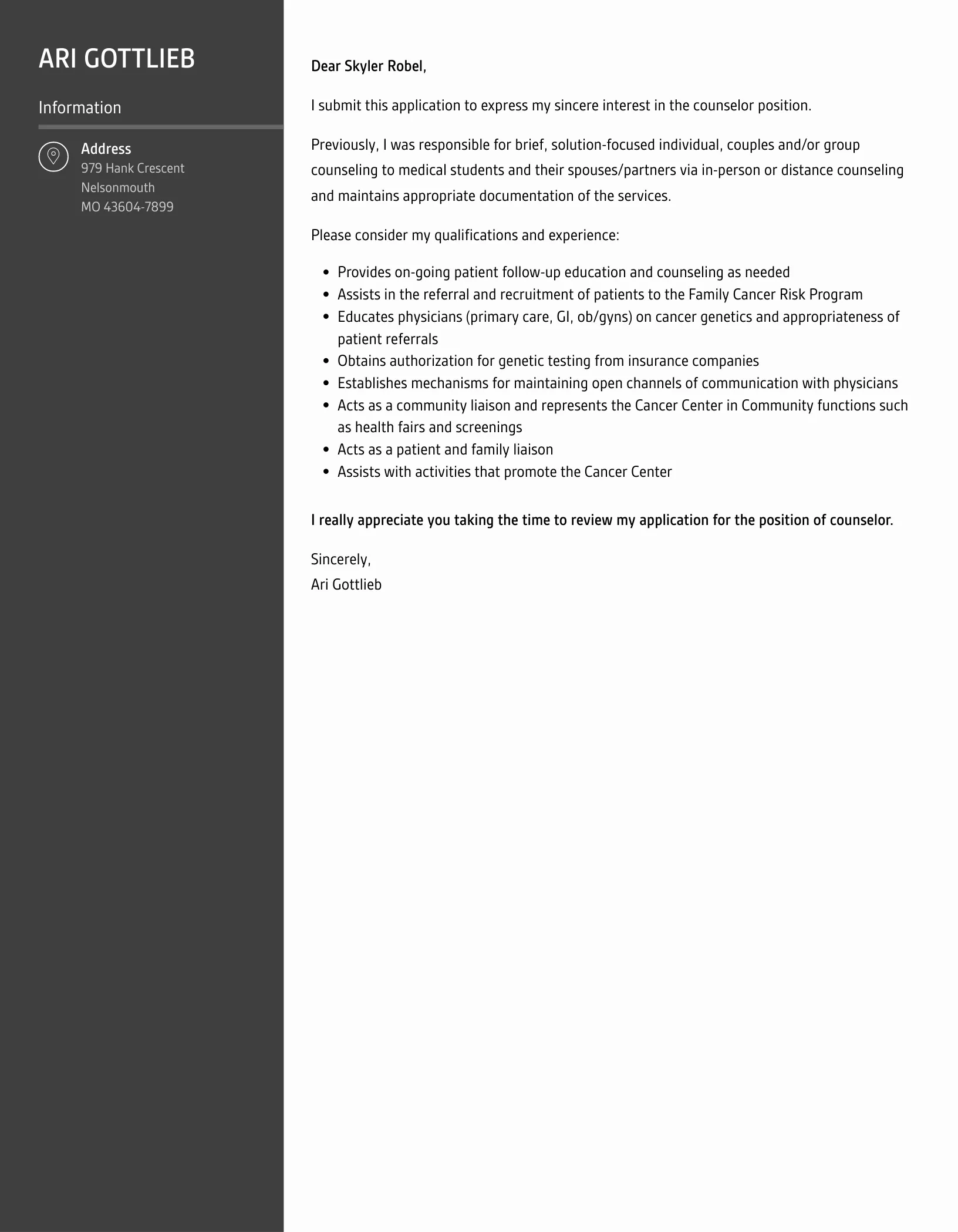
Review examples of effective counselor cover letters to get ideas and inspiration. These examples can provide valuable insights into how to structure your letter, highlight your skills, and express your enthusiasm for the role. It’s helpful to see different approaches and techniques in action. These are examples of how to do it right!
Example 1 School Counselor
A school counselor cover letter should focus on experience with children and young adults, as well as specific skills in educational settings. You would want to include your experience with helping children academically, socially, and personally. Highlight any specific interventions you’ve used or programs you’ve implemented to help students. Showcasing any group therapy experience. It is useful to include any training or certifications you have received. If you have data about student outcomes, be sure to include it.
Example 2 Mental Health Counselor
A mental health counselor cover letter should highlight your experience with patients, specific therapy modalities, and treatment plans. Include any experience working with specific populations or age groups. Describe any specific mental health conditions you have experience treating. Include information about any experience with assessments or diagnosis. If you have experience in a clinical setting, be sure to include this. Show any success with patient outcomes.
Example 3 Career Counselor
A career counselor cover letter should focus on the specific experiences you have helping clients with career planning. Highlight your experience in resume writing, interview skills, and job search strategies. Include details about the specific tools and assessments you have used in the past. If you have experience with a specific industry, include this. Any success stories with clients are helpful to include in your cover letter.