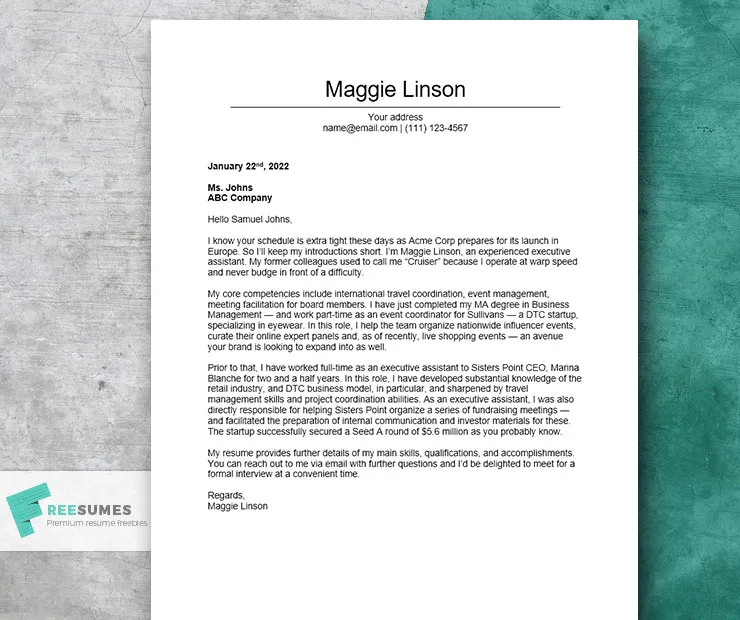
Crafting Your Executive Assistant Cover Letter
The cover letter is your first opportunity to make a strong impression on a potential employer. It’s not just a formality; it’s your chance to showcase your personality, skills, and enthusiasm for the Executive Assistant role. A well-crafted cover letter can significantly increase your chances of landing an interview, while a poorly written one could lead to your application being overlooked. Therefore, it’s crucial to approach the creation of your cover letter with care and attention to detail. Start by understanding the specific requirements of the job description. What skills and experience are they looking for? Tailor your letter to directly address these points. Highlight how your background and abilities align with their needs. Research the company to demonstrate genuine interest and tailor your language to reflect their values and culture. The goal is to show that you understand the role and are a perfect fit for their organization. Remember, your cover letter should be a concise, professional, and compelling introduction, setting the stage for your resume and the interview process.
Highlighting Your Relevant Skills
As an Executive Assistant, you possess a diverse set of skills that are essential to the smooth functioning of an office. In your cover letter, it’s vital to highlight the skills most relevant to the specific job you’re applying for. This demonstrates that you’ve carefully considered the requirements of the role and are capable of meeting its demands. For instance, if the job description emphasizes calendar management and travel arrangements, be sure to showcase your proficiency in these areas. Mention specific software or tools you’re familiar with, such as Microsoft Outlook, Google Calendar, or travel booking platforms. If the role requires strong communication skills, highlight your ability to handle phone calls, draft correspondence, and communicate effectively with various stakeholders. Always provide concrete examples of how you’ve used these skills in previous roles, quantifying your achievements whenever possible. For instance, instead of saying ‘Managed the executive’s schedule,’ you might write ‘Successfully managed the executive’s complex schedule, coordinating meetings, appointments, and travel arrangements for over 50 events annually, resulting in increased efficiency.’ The key is to be specific, results-oriented, and demonstrate your ability to perform the job effectively.
Administrative and Organizational Abilities

Executive Assistants are the linchpins of an organization, often handling administrative and organizational tasks. Your cover letter should clearly showcase your proficiency in these areas. Describe your ability to manage schedules, coordinate meetings, and maintain organized filing systems. Detail your experience with travel arrangements, including booking flights, hotels, and transportation. Mention your familiarity with expense reports, office supply management, and other essential administrative tasks. Use specific examples to illustrate your abilities. For instance, you could write, ‘Streamlined the office filing system, resulting in a 25% reduction in document retrieval time.’ Or, ‘Successfully coordinated travel arrangements for the executive team, ensuring seamless logistics and minimizing disruptions.’ Your goal is to convince the hiring manager that you possess the organizational skills necessary to keep the executive and the office running smoothly.
Communication and Interpersonal Skills
Effective communication is crucial for an Executive Assistant. You are the primary point of contact for the executive, often interacting with clients, vendors, and other stakeholders. In your cover letter, highlight your strong verbal and written communication skills. Describe your experience in handling phone calls, drafting emails, and preparing correspondence. Mention your ability to communicate clearly, concisely, and professionally. Showcase your interpersonal skills, emphasizing your ability to build rapport, handle sensitive information, and maintain confidentiality. Provide examples of how you’ve used these skills in previous roles. For example, you could write, ‘Managed all incoming phone calls, screening and directing them appropriately, ensuring a professional and efficient communication flow.’ Or, ‘Drafted and edited correspondence for the executive, maintaining a consistent and professional tone.’ Your cover letter should demonstrate that you are a confident and effective communicator, capable of representing the executive and the company in a positive light.
Showcasing Your Experience
Your cover letter should provide a concise overview of your relevant work experience. Focus on the positions and achievements that best align with the Executive Assistant role. Start with your most recent experience and work backward. For each role, briefly describe your responsibilities and accomplishments. Quantify your achievements whenever possible, using numbers and data to demonstrate your impact. For example, instead of saying ‘Managed the executive’s schedule,’ you might write ‘Managed the executive’s complex schedule, coordinating meetings, appointments, and travel arrangements for over 50 events annually, resulting in increased efficiency.’ Highlight any special projects or initiatives you’ve been involved in, especially those that demonstrate your initiative and problem-solving skills. Your cover letter should be a compelling narrative that showcases your relevant experience and makes a strong case for why you are the ideal candidate for the job. It should give the reader a clear picture of your professional journey and convince them that you are the right person for the position.
Formatting and Presentation Tips

The format and presentation of your cover letter are just as important as its content. A well-formatted letter is easy to read and leaves a positive impression on the hiring manager. Use a professional font, such as Times New Roman, Arial, or Calibri, and keep the font size between 10 and 12 points. Use consistent formatting throughout the document, including the spacing, margins, and headings. Break up large blocks of text with paragraphs to improve readability. Use bullet points to highlight key skills or accomplishments. Keep your letter concise and to the point, aiming for no more than one page. Proofread your letter carefully to eliminate any errors in grammar or spelling. Ensure your contact information, including your name, phone number, email address, and LinkedIn profile (if you have one), is clearly displayed at the top of the letter. A well-formatted cover letter demonstrates your attention to detail and professionalism, making a strong first impression on potential employers.
Tailoring Your Cover Letter
One of the most important tips for writing a successful cover letter is to tailor it to each job application. Generic, one-size-fits-all cover letters are easily identified and often discarded. Instead, take the time to research the company and the specific requirements of the role. Read the job description carefully and identify the key skills and experience they’re looking for. Then, tailor your cover letter to directly address those requirements. Highlight your relevant skills and experiences, providing specific examples of how you’ve demonstrated them in previous roles. Mention the company by name and express your genuine interest in their organization. Show that you understand their mission, values, and culture. By tailoring your cover letter, you demonstrate that you’ve taken the time to understand the job and are genuinely interested in the opportunity. This increases your chances of catching the hiring manager’s attention and securing an interview. Personalize your cover letter to make it specific, showing that you’ve done your homework and understand the role and the company.
Keywords and Action Verbs
To ensure your cover letter gets noticed by both humans and applicant tracking systems (ATS), strategically incorporate relevant keywords and action verbs. Review the job description carefully and identify the key skills and responsibilities mentioned. Use these keywords throughout your cover letter, especially in the first paragraph and when describing your skills and experience. Action verbs, such as ‘managed,’ ‘coordinated,’ ‘implemented,’ and ‘achieved,’ can help you highlight your accomplishments and make your cover letter more dynamic. Choose action verbs that accurately reflect your responsibilities and accomplishments. Avoid using generic or passive language. Instead, use strong, active verbs that demonstrate your skills and achievements. Some examples of powerful action verbs include: spearheaded, streamlined, optimized, generated, and facilitated. By using relevant keywords and action verbs, you can make your cover letter more compelling and increase your chances of getting noticed by recruiters and hiring managers.
Proofreading and Editing

Before submitting your cover letter, meticulously proofread and edit it to eliminate any errors. Typos, grammatical errors, and inconsistencies can damage your credibility and undermine your chances of getting an interview. Read your letter carefully, paying close attention to grammar, spelling, punctuation, and sentence structure. Use a spell checker and grammar checker, but don’t rely on them entirely. They may miss subtle errors that a human reader would catch. Ask a friend, family member, or career advisor to proofread your letter as well. A fresh pair of eyes can often spot errors that you might have overlooked. Make sure your contact information is accurate and up-to-date. Ensure your letter is formatted correctly and easy to read. Proofreading is a crucial step in the cover letter writing process. A polished and error-free letter demonstrates your attention to detail and professionalism, making a positive impression on potential employers.
Contact Information
Make sure your contact information is accurate and easily accessible. Your cover letter should include your full name, phone number, email address, and LinkedIn profile URL (if you have one). Place this information at the top of your cover letter, usually in a clear and concise format. Use a professional-looking email address. Avoid using nicknames or unprofessional email addresses. Ensure your phone number is accurate and that your voicemail is set up with a professional greeting. If you have a LinkedIn profile, include the URL in your contact information. Your LinkedIn profile is a valuable resource for employers, providing them with additional information about your skills, experience, and professional network. By including your contact information, you make it easy for employers to reach you and express their interest in your application.
Expressing Enthusiasm and Interest
In your cover letter, clearly express your enthusiasm for the Executive Assistant role and your interest in the company. Show that you’ve researched the company and are genuinely excited about the opportunity. Explain why you’re interested in working for the organization and what you admire about their mission, values, or culture. Mention specific aspects of the job that appeal to you. Highlight how your skills and experience align with the company’s needs. Demonstrate your understanding of the role and your willingness to contribute to the team’s success. Use positive and enthusiastic language throughout your cover letter. Avoid sounding generic or indifferent. Show that you’re a motivated and engaged candidate. Your enthusiasm will make a lasting impression and increase your chances of getting an interview.