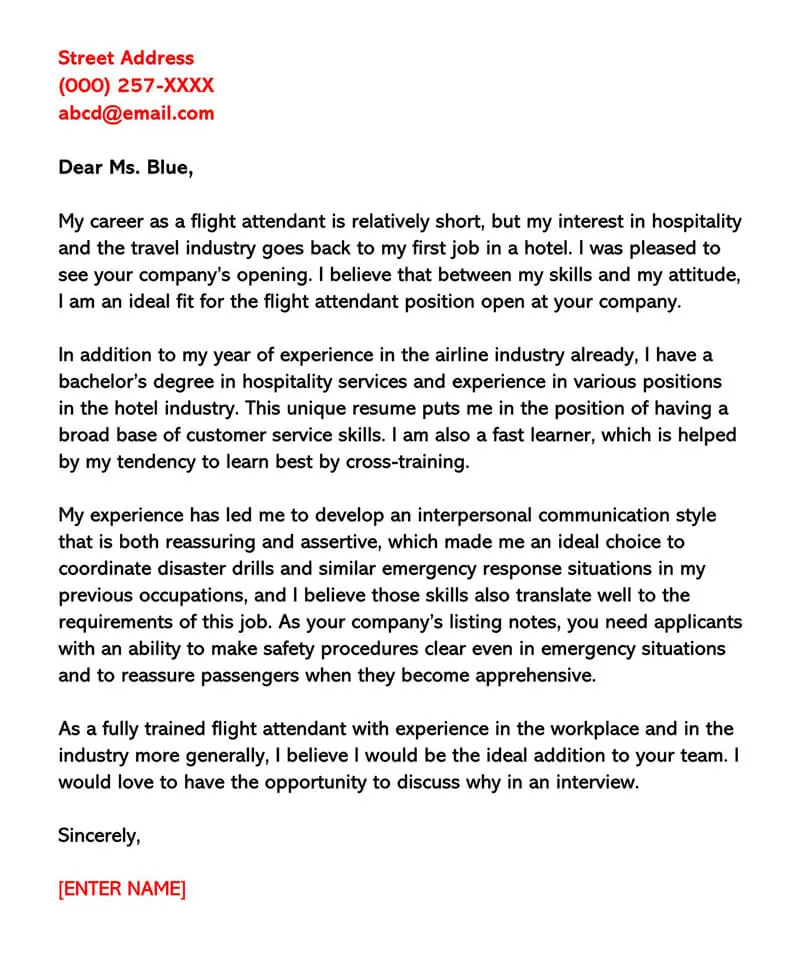
Why a Flight Attendant Cover Letter Matters
A cover letter for a flight attendant position is more than just a formality — it’s your chance to make a strong first impression and stand out from other applicants. In a highly competitive field, a well-crafted cover letter can be the key to landing an interview. It allows you to showcase your personality, highlight your relevant skills and experiences, and demonstrate your genuine interest in the role and the airline. It’s a crucial part of your job application, and taking the time to create a compelling letter can significantly increase your chances of getting hired. With the perfect cover letter, your chances of being selected are dramatically increased as you demonstrate to the hiring manager the qualities they look for.
Highlighting Your Skills and Experience
Your cover letter should act as a highlight reel of your skills and experience, tailored specifically to the requirements of a flight attendant role. The most successful candidates show the hiring manager why they would excel at the job. Consider the key skills that airlines look for and how you can demonstrate these abilities through your past experiences. Think about how you’ve provided excellent customer service, handled difficult situations with grace, and worked effectively in a team. The goal is to make a strong case, showing the hiring manager that you are the best candidate for the role, and that you are a great fit for their company. Focus on showing how you can handle high-pressure situations.
Customer Service Prowess

Excellent customer service is the cornerstone of a flight attendant’s job. Highlight any previous experience where you’ve gone above and beyond to assist customers or resolve issues. Describe specific situations where you provided exceptional service, dealt with complaints, or exceeded customer expectations. Focus on your ability to remain calm, empathetic, and helpful, even under pressure. Provide examples of how you handled difficult customers or situations and the positive outcomes that resulted. Use action verbs to show your customer service skills in action, like ‘assisted,’ ‘resolved,’ ‘supported,’ or ’exceeded’. Showing your customer service prowess gives the hiring manager confidence in your abilities and increases your odds of being hired.
Communication and Interpersonal Skills
Effective communication and strong interpersonal skills are essential for flight attendants. Highlight your ability to communicate clearly and concisely, both verbally and in writing. Mention any experience you have interacting with diverse groups of people, resolving conflicts, or explaining complex information in a simple way. Show your ability to be an active listener, understand others’ perspectives, and build rapport. Talk about any experience working in a team and your ability to collaborate effectively. Demonstrate how you can create a positive and welcoming environment for passengers. Your success will come down to showing how you can provide amazing support, guidance, and care for each passenger.
Adaptability and Problem-Solving
Flight attendants must be adaptable and able to solve problems on the fly. Highlight any experience where you demonstrated flexibility, resourcefulness, and the ability to think on your feet. Describe situations where you had to adjust to unexpected circumstances, make quick decisions, or find creative solutions to challenges. Show your ability to remain calm under pressure, prioritize tasks, and handle multiple responsibilities simultaneously. Mention any training or experience in emergency procedures or first aid. Demonstrate how you can handle unexpected situations and take charge when necessary. This is a crucial skill, and highlighting it correctly in your cover letter makes you a great candidate.
Showcasing Relevant Experience

Your cover letter should focus on experiences that are directly relevant to the flight attendant role. This does not necessarily mean you need to have previous experience as a flight attendant, but you should focus on transferable skills from other roles. Highlight any experience in customer service, hospitality, or any other roles that required you to interact with the public. Mention any experience in a fast-paced environment or in a role that required multitasking and problem-solving. Make sure to tailor your experience to the specific requirements of the job description. Show the hiring manager how your past experience has prepared you for this role. This showcases how your past work experience can translate to your new role.
Previous Customer-Facing Roles
Emphasize any experience you have in customer-facing roles, such as a retail, hospitality, or tourism. Highlight the skills you gained, such as providing excellent customer service, handling complaints, and resolving conflicts. Describe specific situations where you went above and beyond to assist customers or exceed their expectations. Show your ability to work in a fast-paced environment and handle multiple responsibilities simultaneously. If you don’t have customer service experience, think about experiences where you demonstrated a willingness to help others or handle difficult people. These examples are helpful to showcase your skills and make you an attractive candidate.
Experience with Conflict Resolution
Conflict resolution skills are valuable for flight attendants. Highlight any experience you have in resolving conflicts, mediating disputes, or defusing tense situations. Describe specific situations where you had to remain calm and professional while dealing with difficult people or challenging circumstances. Show your ability to listen actively, understand different perspectives, and find mutually agreeable solutions. If you have experience in customer service or any other roles where you had to handle complaints or resolve issues, make sure to emphasize these experiences. Your approach to conflict is an important factor for hiring managers, so include specific examples to showcase your skills.
Tailoring Your Cover Letter

A generic cover letter won’t impress hiring managers. Tailor your cover letter to each specific job application. Customizing your letter shows that you’ve taken the time to understand the airline’s needs and that you’re genuinely interested in the position. Address the letter to the hiring manager by name if possible. Research the airline’s values, mission, and culture, and incorporate these into your letter. Highlight the specific skills and experiences that align with the job description. By showing that you understand the company and the specific role, you’ll stand out from the competition. Take the time to learn about the airline’s values, mission, and culture to create a strong impression.
Researching the Airline’s Values
Before writing your cover letter, research the airline’s values and mission statement. Many airlines have a strong focus on customer service, safety, and teamwork. Understanding these values will help you tailor your cover letter to align with their priorities. Look for information on the airline’s website, social media channels, and news articles. Identify the key values that resonate with you and incorporate them into your letter. For example, if the airline emphasizes safety, you could highlight your attention to detail and your ability to follow procedures. If they value teamwork, you could describe your experience working collaboratively. The more you know about the company, the better you can tailor your cover letter.
Using Keywords from the Job Description
Carefully review the job description and identify the keywords that are most important. These keywords typically describe the skills, experience, and qualifications that the airline is seeking. Incorporate these keywords naturally throughout your cover letter. For example, if the job description mentions ‘customer service skills,’ make sure to highlight your customer service experience. If it mentions ’teamwork,’ describe your ability to work effectively in a team. Using keywords helps your cover letter get noticed by applicant tracking systems and demonstrates to the hiring manager that you meet the requirements of the job. Ensure these are incorporated naturally into your letter to make it more relevant and appealing.
Formatting and Structure

A well-formatted cover letter is easy to read and visually appealing. Use a professional font, such as Times New Roman or Arial, and keep the font size between 11 and 12 points. Use clear headings and subheadings to organize your letter and make it easy to scan. Keep paragraphs concise and to the point. Maintain consistent formatting throughout your letter. Avoid using excessive colors, graphics, or formatting styles. The goal is to create a clean, professional appearance. Proofread your cover letter carefully to ensure there are no typos or grammatical errors. A well-formatted cover letter demonstrates your attention to detail and professionalism.
Opening Paragraph
Your opening paragraph should immediately grab the reader’s attention and make them want to continue reading. Start by stating the position you are applying for and where you saw the job posting. Briefly introduce yourself and highlight your key skills or experiences that make you a good fit for the role. Express your enthusiasm for the position and the airline. Keep the opening concise and to the point, and focus on showing the hiring manager why you would be a great fit. Make your introduction compelling and make the hiring manager want to read on.
Body Paragraphs
The body of your cover letter is where you showcase your skills, experience, and personality. Use several paragraphs to highlight your most relevant qualifications and accomplishments. Provide specific examples to demonstrate your skills. Quantify your achievements whenever possible. For example, instead of saying ‘I improved customer satisfaction,’ say ‘I improved customer satisfaction by 15%.’ Use action verbs to describe your accomplishments and skills. Tailor each paragraph to the specific requirements of the job description. Make sure to include examples and make your achievements quantifiable to demonstrate the effectiveness of your performance.
Closing Paragraph

Your closing paragraph should leave a lasting positive impression. Reiterate your enthusiasm for the position and the airline. Summarize your key qualifications and reiterate your interest in the role. Thank the hiring manager for their time and consideration. Include a call to action, such as ‘I look forward to hearing from you’ or ‘I am available for an interview at your earliest convenience.’ End with a professional closing, such as ‘Sincerely’ or ‘Best regards,’ followed by your name and contact information. Ensure your closing paragraph reiterates your enthusiasm and interest.
Proofreading and Editing
Proofreading and editing your cover letter is essential. Typos and grammatical errors can make you look unprofessional and can damage your chances of getting an interview. Always proofread your letter carefully before submitting it. Use spell check and grammar check tools, but don’t rely on them completely. Read your letter aloud to catch any awkward phrasing or errors. Ask a friend or family member to review your letter for a second opinion. Ensure that your cover letter is error-free and conveys a strong message. The smallest errors can be the difference between getting hired and being passed over.
Common Mistakes to Avoid
Avoiding common mistakes is crucial to ensure your cover letter makes a positive impression. Make sure to avoid generic cover letters, typos and grammatical errors, and failing to highlight relevant skills. These errors can easily cause your application to be rejected. Take the time to proofread your letter and tailor it to each specific job application. By avoiding these common mistakes, you can increase your chances of getting an interview and landing your dream job as a flight attendant.
Generic Cover Letters

Avoid using generic cover letters that are not tailored to the specific job application. Generic cover letters show that you haven’t taken the time to understand the airline’s needs or that you’re not genuinely interested in the position. Always customize your cover letter to each job application, and focus on highlighting your skills and experiences that align with the job description. Generic cover letters are easily identified by hiring managers. Tailor your letter to show your enthusiasm and understanding of the airline.
Typos and Grammatical Errors
Typos and grammatical errors can make you look unprofessional and damage your chances of getting an interview. Always proofread your cover letter carefully before submitting it. Use spell check and grammar check tools, but don’t rely on them completely. Read your letter aloud to catch any awkward phrasing or errors. Ask a friend or family member to review your letter for a second opinion. Typos and grammatical errors show a lack of attention to detail. Taking the time to proofread your cover letter is a simple way to make a positive impression and ensure your application gets noticed.
Failing to Highlight Relevant Skills
Make sure your cover letter effectively highlights the skills and experiences that are most relevant to the flight attendant role. Take the time to carefully review the job description and identify the key skills and qualifications the airline is seeking. Use specific examples to demonstrate your skills and accomplishments. Quantify your achievements whenever possible. Tailor your cover letter to the specific requirements of the job description. Highlighting relevant skills is crucial to show the hiring manager that you have the qualifications to succeed in the role. Failure to highlight these skills may result in the application being rejected, so always tailor your letter to the job.
The Power of a Strong Cover Letter

A strong cover letter is a powerful tool that can make a significant difference in your job search. By following these tips, you can create a compelling cover letter that highlights your skills, experience, and personality. Your cover letter is an opportunity to make a strong first impression and stand out from other applicants. Take the time to craft a well-written, tailored cover letter, and you’ll significantly increase your chances of landing an interview and getting hired as a flight attendant. Your cover letter is your chance to shine and show the hiring manager why you are the best candidate for the job. A strong cover letter is your best shot at a new career.