Understanding the Importance of an Engineering Cover Letter
In the competitive field of engineering, a well-crafted cover letter is not just a formality it’s a critical tool that can significantly boost your chances of landing your dream job. Unlike your resume, which provides a concise overview of your qualifications, a cover letter allows you to delve deeper, showcasing your personality, passion, and suitability for the specific role and company. It serves as your first impression, and a strong one can make you stand out from the crowd of applicants, ultimately leading to an interview invitation. Remember, the purpose of a cover letter is to persuade the hiring manager that you are not only qualified but also the ideal candidate for the position.
Why a Cover Letter Matters
A cover letter provides the opportunity to personalize your application. It allows you to connect your skills and experience to the specific requirements of the job. By addressing the hiring manager directly and expressing your enthusiasm for the position, you demonstrate your genuine interest and commitment. Moreover, a cover letter is a space to tell your story, explaining the context behind your achievements and illustrating how your skills align with the company’s needs. It’s a chance to showcase your communication skills, and to emphasize why you are the right person for the job. Without a cover letter, you risk being seen as a generic applicant who hasn’t taken the time to understand the role or the company.
Highlighting Your Skills and Experience

Your cover letter is the perfect place to highlight the skills and experience that make you a strong candidate. While your resume lists your qualifications, your cover letter allows you to elaborate on them. Focus on the skills that are most relevant to the job description, and provide specific examples of how you’ve utilized those skills in the past. Quantify your achievements whenever possible. Instead of saying you ‘improved efficiency,’ state that you ‘increased efficiency by 15% through the implementation of a new system.’ This level of detail and specificity will make your application much more compelling to the hiring manager. Remember, the goal is to show how your abilities align with the job requirements.
Key Elements of a Compelling Engineering Cover Letter
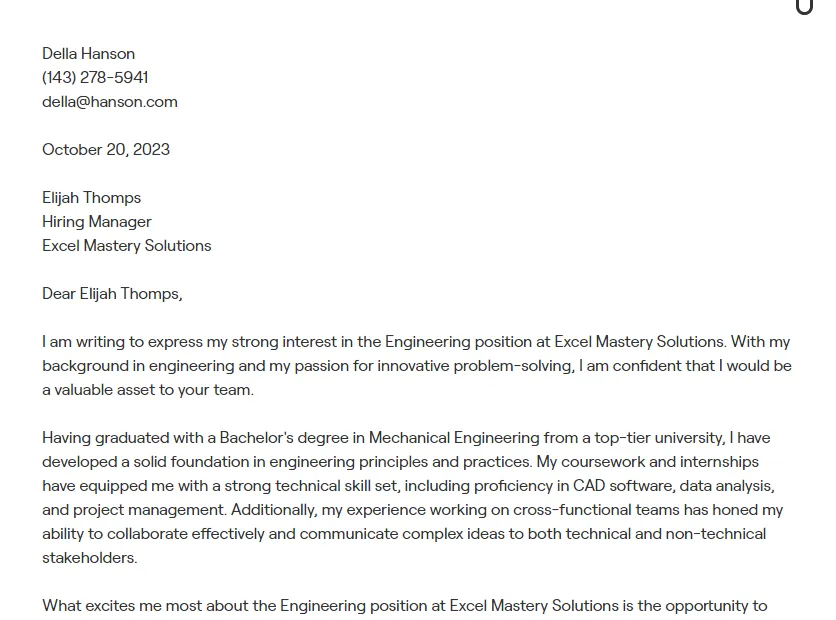
A compelling cover letter includes several key elements. Start with a professional header that includes your contact information and the date. Address the hiring manager by name if possible; doing so demonstrates your research and initiative. Your opening paragraph should immediately capture the reader’s attention by stating your interest in the position and briefly highlighting your most relevant qualifications. The body of the letter should showcase your skills, experiences, and achievements, using specific examples to support your claims. Finally, conclude with a strong closing paragraph that reiterates your interest, thanks the reader for their time, and expresses your eagerness for an interview.
Formatting Your Engineering Cover Letter
The format of your cover letter is as important as its content. Choose a professional font, such as Times New Roman, Arial, or Calibri, and use a font size between 10 and 12 points. Ensure your letter is well-formatted with consistent margins and spacing. Use clear headings and bullet points to make your letter easy to read and navigate. Keep the letter concise, ideally no more than one page. Avoid using jargon or overly complex language. Prioritize clarity and readability. A well-formatted letter is a sign of professionalism and attention to detail, both essential qualities in engineering.
Contact Information and Date

At the top of your cover letter, include your full name, address, phone number, and email address. This information should be aligned to the left or centered. Below your contact information, include the date. Ensure the date is formatted correctly and consistent with the standard format for the region in which you are applying. This information allows the hiring manager to easily contact you.
The Salutation - Addressing the Hiring Manager
Addressing the hiring manager by name is crucial. Research the company and the specific hiring manager. If you are unable to find a name, use a professional salutation such as ‘Dear Hiring Manager’. Avoid generic greetings like ‘To Whom It May Concern’. A personalized salutation demonstrates your attention to detail and your genuine interest in the position. It shows you have taken the time to research the company and the hiring process.
Crafting a Strong Opening Statement
Your opening statement should immediately grab the reader’s attention. State the position you are applying for and where you found the job posting. Briefly highlight your key qualifications and express your enthusiasm for the opportunity. The opening paragraph is your chance to make a positive first impression, so make it count. Show your excitement for the role and the company, and briefly hint at what makes you a strong candidate.
Showcasing Your Technical Skills and Projects

Engineering roles require a specific set of technical skills. Your cover letter should highlight these skills and provide examples of how you’ve used them in the past. Mention specific software, tools, and technologies you are proficient with. Describe relevant projects you’ve worked on, detailing your role and the outcomes you achieved. The more specific you are, the better. It helps the hiring manager visualize your capabilities. Include details about the challenges you overcame and the solutions you developed. Tailor your description to align with the requirements of the job description.
Quantifying Your Achievements
Whenever possible, quantify your achievements to demonstrate your impact. Use numbers and metrics to illustrate your successes. Instead of saying you ‘improved efficiency’, specify by how much, for example, ‘increased efficiency by 20%’. If you reduced costs, state the amount. If you improved a design, mention the performance improvements. Quantifiable results are more persuasive than vague statements, providing clear evidence of your abilities and the value you can bring to the company. This helps the hiring manager quickly assess your contributions and impact.
Tailoring Your Letter to the Job Description
Each cover letter should be tailored to the specific job description. Carefully read the job posting and identify the key requirements. Then, customize your cover letter to address these requirements. Highlight the skills and experiences that align with the job’s needs and use the same keywords and phrases from the job description. Showing you have carefully read and understood the job requirements shows your interest in the role and that you’re a great fit for it. This customization process shows your ability to adapt and understand what the company requires.
Demonstrating Your Problem-Solving Abilities

Engineering is all about solving problems, so make sure your cover letter reflects this skill. Describe a challenging problem you faced in a previous project or role. Explain the steps you took to analyze the problem, the solutions you considered, and the solution you ultimately implemented. Highlight your problem-solving approach, including your ability to think critically, analyze data, and develop innovative solutions. This demonstrates your ability to tackle challenges and contribute effectively.
Highlighting Relevant Experience
Focus on the most relevant experience you have for the job. Prioritize the projects and roles that best demonstrate your skills and how they align with the job requirements. Explain your responsibilities in each role, emphasizing your achievements and contributions. Give specific examples of how you’ve used your skills to overcome challenges or achieve positive outcomes. Don’t just list your experience; provide context and demonstrate the impact of your work.
Showcasing Your Soft Skills
While technical skills are essential, don’t underestimate the importance of soft skills. Highlight your communication, teamwork, leadership, and problem-solving abilities. Provide examples of how you’ve collaborated with others, resolved conflicts, or led a team. Demonstrate your ability to communicate technical information clearly and concisely, both verbally and in writing. Showcase your ability to adapt to new challenges and work well under pressure. These skills are as important as your technical abilities in the workplace.
Engineering Cover Letter Do’s and Don’ts

DO tailor your letter to each job. DO highlight your relevant skills and experience. DO quantify your achievements. DO proofread carefully. DO use a professional tone and format. DO research the company and the hiring manager. DON’T use generic templates. DON’T make spelling or grammatical errors. DON’T exceed one page. DON’T be negative or make excuses. By following these guidelines, you can create a cover letter that effectively showcases your qualifications and increases your chances of getting hired.
Proofreading and Editing Your Cover Letter
Proofreading is essential. Carefully review your cover letter for any spelling, grammar, or punctuation errors. Errors can undermine your credibility and demonstrate a lack of attention to detail. Read your letter aloud to catch any awkward phrasing or unclear sentences. Ask a friend, mentor, or career advisor to review your letter as well. A fresh pair of eyes can often spot errors that you might miss. Correcting any mistakes ensures you make a positive impression.
Common Mistakes to Avoid
There are several common mistakes to avoid when writing an engineering cover letter. Do not use generic templates; always customize your letter for each job. Avoid simply restating your resume; instead, provide additional details and context. Don’t make spelling or grammatical errors, and do not exceed one page. Avoid negative language or making excuses. Be positive, enthusiastic, and focused on your strengths and qualifications. A well-crafted cover letter should emphasize your fit for the role and showcase your enthusiasm and skills.
Best Practices for Submitting Your Cover Letter

Always follow the application instructions provided by the employer. If the instructions specify a particular format or method of submission, make sure to adhere to them. If the instructions say to send the cover letter and resume as a single PDF, do that. Double-check that all your attachments are included and in the correct format before submitting your application. Keep a copy of your cover letter and resume for your records. Following these practices will increase your chances of being considered for the position.