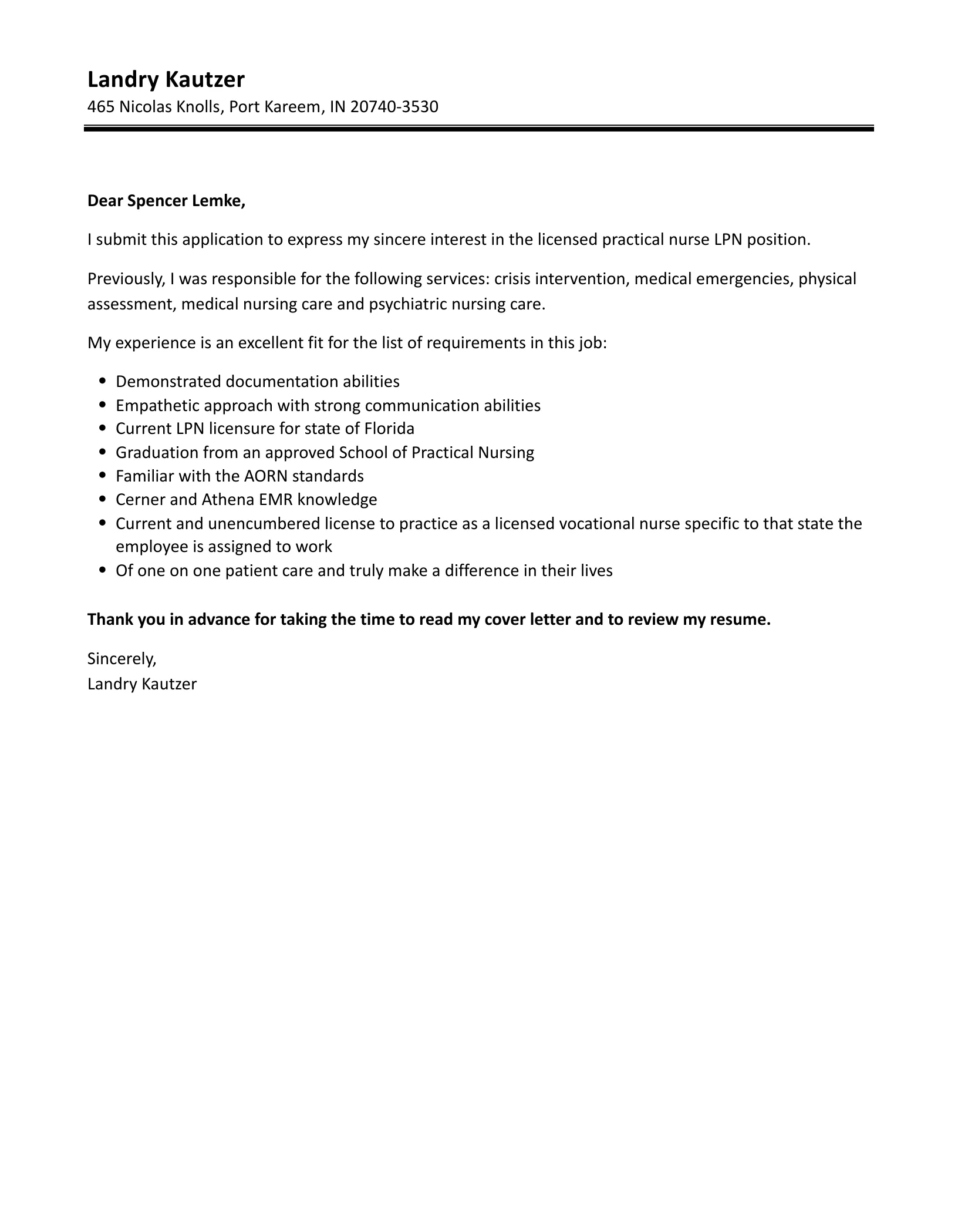
What is an LPN Cover Letter
An LPN (Licensed Practical Nurse) cover letter is a crucial document that accompanies your resume when applying for nursing positions. It serves as your first introduction to a potential employer, offering you a unique opportunity to showcase your personality, enthusiasm, and qualifications beyond the confines of your resume. Unlike a resume, which provides a factual overview of your experience and skills, a cover letter allows you to express your interest in the specific role and explain why you are the ideal candidate. It enables you to highlight relevant experiences, connect your skills to the job requirements, and demonstrate your understanding of the healthcare setting. Therefore, crafting a compelling cover letter is essential for making a positive first impression and increasing your chances of landing an interview for your desired LPN position. A well-written cover letter demonstrates your professionalism, attention to detail, and genuine interest in the opportunity.
Why is an LPN Cover Letter Important
The importance of an LPN cover letter cannot be overstated in the job application process. First and foremost, it offers you the chance to personalize your application. By tailoring the letter to each specific job and employer, you can demonstrate your genuine interest in the role and the organization. This personalized approach sets you apart from generic applicants who send out the same resume and cover letter to every job. Moreover, an effective cover letter allows you to expand on your resume by providing more detail about your experiences and skills. You can elaborate on specific achievements, explain how your previous roles have prepared you for the new position, and highlight any unique qualifications that make you stand out. The cover letter also provides an opportunity to showcase your communication skills, which are essential in nursing. A well-written cover letter demonstrates your ability to articulate your thoughts clearly and concisely, a critical skill when interacting with patients, doctors, and other healthcare professionals. Finally, a cover letter allows you to address any potential concerns or gaps in your resume, such as a career change or extended absence. By proactively explaining these situations, you can demonstrate your professionalism and address any potential red flags head-on, helping you make a strong case for your candidacy.
Top 5 Tips for a Winning LPN Cover Letter

Creating a compelling LPN cover letter can significantly increase your chances of securing an interview. Here are the top 5 tips to help you write a winning letter that impresses potential employers. By following these guidelines, you can create a cover letter that highlights your skills, experiences, and dedication, increasing your chances of success in your job search.
Highlight Your Skills and Experience
When writing your LPN cover letter, it’s crucial to focus on showcasing the skills and experiences that align with the job requirements. Review the job description carefully and identify the key skills and qualifications the employer is seeking. Then, provide specific examples from your past experiences where you have demonstrated these skills. For instance, if the job description emphasizes patient communication, describe a situation where you effectively communicated with a patient to explain a complex medical procedure or provided emotional support. If the job requires experience in medication administration, describe your proficiency in this area, highlighting your attention to detail and adherence to safety protocols. Furthermore, emphasize your clinical skills, such as wound care, vital sign monitoring, and assisting with medical procedures. By using concrete examples, you can demonstrate your competence and show the employer how you can contribute to their team. Remember to tailor your skills and experiences to each specific job, making it clear why you are the best fit for the role.
Quantify Your Achievements
To truly impress potential employers, it’s important to quantify your achievements whenever possible. Rather than simply stating that you improved patient care, provide specific data to illustrate your impact. For example, you can mention a reduction in patient falls by a certain percentage during your shifts or an improvement in patient satisfaction scores based on your interventions. If you have experience training new nurses, you can mention the number of nurses you have trained or the positive feedback you received on your training sessions. Highlighting any awards or recognition you have received is also essential. Quantifying your achievements provides concrete evidence of your skills and contributions, making your cover letter more compelling and memorable. It demonstrates to the employer that you are not only skilled but also results-oriented. To make your cover letter stand out, take the time to gather data and statistics that showcase your professional successes.
Tailor Your Letter to the Job

One of the biggest mistakes applicants make is sending a generic cover letter to every job application. To create a winning LPN cover letter, it’s essential to tailor each letter to the specific job and employer. Start by carefully reviewing the job description and identifying the key requirements and qualifications. Then, highlight the skills and experiences that align with these requirements, providing specific examples of how you have demonstrated them in the past. Research the healthcare facility or organization to gain a better understanding of their mission, values, and patient care approach. In your letter, express your genuine interest in working for this particular employer and explain why you are drawn to their organization. When tailoring your cover letter, consider the tone and style of the company. For example, if the organization emphasizes teamwork, highlight your collaborative skills and experiences. Customizing your cover letter will show the employer that you have taken the time to understand their needs and that you are genuinely interested in the role. It will also make your application stand out from the crowd of generic applications.
Proofread and Edit Meticulously
Before submitting your LPN cover letter, it’s crucial to proofread and edit it meticulously. Typos, grammatical errors, and formatting inconsistencies can undermine your professionalism and create a negative impression. Start by carefully reviewing your letter for any spelling or grammatical errors. Use a grammar checker tool, but don’t rely solely on it; always read through the letter yourself. Pay close attention to sentence structure, punctuation, and capitalization. Ensure that your letter is well-organized, with clear and concise paragraphs. Review your letter’s tone to ensure it is appropriate for a professional setting. Consider the length of your letter; aim for one page unless otherwise specified. Ask a friend, family member, or career counselor to read your letter and provide feedback. Fresh eyes can often catch errors that you might have missed. By proofreading and editing your cover letter thoroughly, you demonstrate your attention to detail, which is a critical skill in nursing.
Include a Strong Call to Action
To make your LPN cover letter even more effective, include a strong call to action at the end. The call to action is a concise statement that encourages the employer to take the next step in the hiring process. Instead of ending your letter with a generic closing, such as “Sincerely,” make a specific request or express your desire to move forward. For example, you can state your availability for an interview and how you can be reached. You can also express your enthusiasm for the opportunity to discuss your qualifications further. If the job posting specifies a preferred method of contact, be sure to follow those instructions. By including a strong call to action, you take ownership of the application process and show the employer that you are proactive and eager for the opportunity. Make sure your call to action is polite, professional, and aligns with the tone of your letter.
LPN Cover Letter Examples to Inspire You

Reviewing LPN cover letter examples can provide valuable insights and guidance as you craft your own. These examples can help you understand the common formats, language styles, and content elements that successful cover letters often incorporate. Search online for LPN cover letter templates or examples. Pay attention to how the writers highlight their skills, quantify their achievements, and express their enthusiasm for the role. Look for examples that align with your experience and the type of position you are seeking. While using examples as inspiration, be sure to customize your own letter to reflect your unique experiences and qualifications. The goal is to create a cover letter that is both professional and authentic, showcasing what makes you a strong candidate for the job. Adapt the best practices from these examples, but always ensure that your cover letter reflects your own voice, personality, and experiences. This will help your application stand out.
Example Cover Letter for a Licensed Practical Nurse
Here is a sample cover letter for a Licensed Practical Nurse. Remember, the content should be tailored to your specific experiences and the job you are applying for.
[Your Name] [Your Address] [Your Phone Number] [Your Email]
[Date]
[Hiring Manager Name] (if known), or “Hiring Manager” [Facility Name] [Facility Address]
Dear [Mr./Ms./Mx. Last Name or Hiring Manager],
I am writing to express my enthusiastic interest in the Licensed Practical Nurse position at [Facility Name], as advertised on [Platform where you saw the ad]. With my [Number] years of experience in providing compassionate and skilled patient care, I am confident that I possess the skills and dedication to excel in this role.
In my previous role at [Previous Facility Name], I was responsible for [List key responsibilities, e.g., administering medications, monitoring vital signs, assisting with patient care]. I am adept at [List key skills, e.g., wound care, patient education, electronic health record management] and committed to providing a safe and supportive environment for patients. I have a proven track record of [Quantifiable achievement, e.g., reducing patient falls by 15%, improving patient satisfaction scores].
I am a highly motivated and detail-oriented individual with a strong work ethic and a passion for nursing. I am eager to contribute my skills and expertise to [Facility Name] and help your team provide excellent patient care. I am particularly drawn to [Mention something specific about the facility that attracts you].
I am available for an interview at your earliest convenience. Thank you for your time and consideration. I look forward to hearing from you soon.
Sincerely, [Your Signature] [Your Typed Name]
Mistakes to Avoid in Your LPN Cover Letter
Avoiding common mistakes in your LPN cover letter can significantly improve your chances of landing an interview. One of the most frequent errors is failing to tailor the cover letter to the specific job and employer. Sending a generic letter shows a lack of genuine interest and can make your application look uninspired. Another mistake is including excessive information that is already in your resume. The cover letter should expand upon your qualifications, not simply repeat them. Other errors include spelling and grammatical mistakes, which can damage your credibility. Poor formatting can also make your letter difficult to read. Another mistake is using jargon or overly complex language. Keep your language simple and easy to understand. Finally, a cover letter that is too long or too short can be a turn-off. Aim for a concise, one-page letter that highlights your key qualifications. By avoiding these pitfalls, you can create a cover letter that effectively showcases your skills and increases your chances of getting hired.