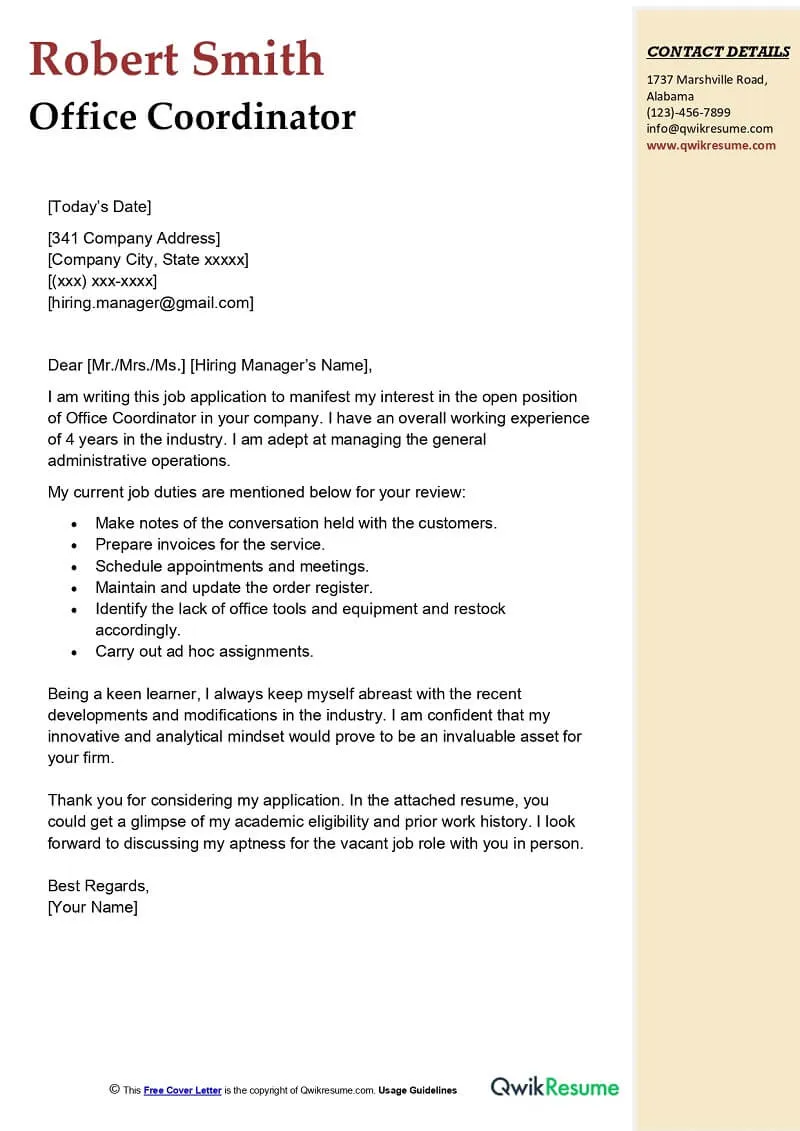
Crafting Your Office Coordinator Cover Letter
A well-crafted cover letter is your first opportunity to make a strong impression on a potential employer. For an Office Coordinator position, this document serves as more than just an introduction it’s a chance to showcase your organizational skills, attention to detail, and understanding of the role. This guide will walk you through how to write an outstanding cover letter that grabs the attention of hiring managers and sets you apart from the competition. The goal is to create a compelling narrative that highlights your qualifications and demonstrates your genuine interest in the position and the company. A strong cover letter often leads to the next step of the hiring process.
Understanding the Role of an Office Coordinator
Before diving into the specifics of writing your cover letter, it’s essential to understand the core responsibilities of an Office Coordinator. This role is pivotal in ensuring the smooth and efficient operation of an office environment. Office Coordinators are often the first point of contact for visitors and employees alike, making them vital in maintaining a positive and productive workplace. Understanding the multifaceted nature of the job will allow you to tailor your cover letter to reflect the specific skills and experiences that are most relevant and sought after by employers. Knowing the role will help showcase your interest in the details of the job.
Key Responsibilities of an Office Coordinator

Office Coordinators handle a wide array of tasks. These include managing office supplies, coordinating schedules, answering phones, and greeting visitors. They often assist with administrative duties, such as data entry, filing, and preparing documents. Effective Office Coordinators also play a key role in maintaining office equipment, managing mail and deliveries, and assisting with event planning. Depending on the organization, they may also be involved in onboarding new employees and supporting HR-related tasks. They are often the glue that holds a work environment together, so having a comprehensive understanding of the duties involved in this role is a must when writing your cover letter.
Essential Skills for Office Coordinators
Employers seek candidates with a blend of soft and hard skills. Communication, both written and verbal, is critical, as is the ability to multitask and prioritize tasks. Proficiency in office software such as Microsoft Office (Word, Excel, Outlook) is typically required. Organizational skills are vital, along with the ability to manage time effectively. A strong work ethic, problem-solving abilities, and a customer-service orientation are also highly valued. Highlighting these skills in your cover letter, along with specific examples, will strengthen your candidacy. Ensure you are up to date with the software, as the office environment is always changing.
Formatting Your Office Coordinator Cover Letter
The layout of your cover letter is as important as its content. A well-formatted letter is easy to read and conveys professionalism. Use a clear and professional font like Arial or Times New Roman, with a font size between 10 and 12 points. Ensure that your letter is single-spaced, with a space between each paragraph. Maintain consistent margins and use bullet points or lists to break up large blocks of text, making it easier for the reader to scan. Properly formatting your cover letter demonstrates that you have attention to detail, an important skill for an Office Coordinator. A well-formatted cover letter is your chance to impress an employer.
Contact Information & Date

At the top of your cover letter, include your contact information, such as your name, phone number, email address, and optionally, your LinkedIn profile URL. Following this, include the date you are sending the letter. This information should be aligned to the left or right, depending on your preference, but should be consistent throughout the document. Using this method shows you are able to follow basic guidelines and requirements.
Recipient Details
Directly below your contact information and the date, include the recipient’s information. This includes the name of the hiring manager (if you know it), their title, the company name, and the company’s address. Address the letter to a specific person whenever possible, as it demonstrates that you have taken the time to research the company and the role. If you don’t know the hiring manager’s name, research the company’s website or LinkedIn. When you tailor the letter you improve your chances.
Salutation & Introduction
Begin your cover letter with a professional salutation, such as ‘Dear Mr./Ms. [Last Name]’ or ‘Dear Hiring Manager.’ Your introduction should immediately capture the reader’s attention by stating the position you are applying for and where you found the job posting. Briefly mention your most relevant skills and experience, and express your enthusiasm for the opportunity. This is your chance to make a positive first impression and encourage the reader to continue reading. Keep the introduction concise and directly to the point, so you can grab the attention of the employer.
Body Paragraphs

The body paragraphs are where you expand on your qualifications and demonstrate your fit for the role. Structure your body paragraphs to highlight your most relevant skills and experience. Each paragraph should focus on a specific aspect of your qualifications and support it with concrete examples. Use action verbs to describe your accomplishments and quantify your achievements whenever possible. It’s crucial to tailor the content to match the requirements of the job description, showing the hiring manager that you understand the role and what the company is looking for.
Highlighting Relevant Experience
In your cover letter, focus on experiences that align with the responsibilities outlined in the job description. Provide details of your previous roles that showcase your organizational, communication, and administrative skills. When describing your experience, use the STAR method (Situation, Task, Action, Result) to provide context and demonstrate your abilities. For instance, describe a time when you managed multiple projects simultaneously, how you prioritized tasks, the actions you took, and the positive outcomes achieved. By doing so, you give the reader concrete examples of how you have excelled in similar roles.
Showcasing Key Skills
Showcase your skills by providing examples of how you have used them effectively in past roles. If the job description requires proficiency in Microsoft Office, give examples of how you used Excel to create spreadsheets or Word to manage documents. If attention to detail is essential, describe a time when you identified and corrected an error in a critical document. If you have strong communication skills, provide examples of successful interactions, presentations, or written communications. By providing concrete examples of your skills, you can demonstrate your competence and increase your chances of securing an interview. Use the job posting to determine which skills are a priority.
Quantifying Achievements

Quantifying your achievements makes your cover letter more impactful and memorable. Whenever possible, use numbers and data to illustrate your accomplishments. For example, instead of saying you improved office efficiency, state that you reduced supply costs by 15% or improved the accuracy of data entry by 20%. If you managed a project, mention the number of people involved, the budget, and the deadlines you met. These types of specific details demonstrate your ability to achieve results and make a significant contribution to the company. This is a great way to impress an employer.
Closing Your Cover Letter
Your closing paragraph should reiterate your interest in the position and the company. Summarize your key qualifications and express your confidence in your ability to succeed in the role. Thank the hiring manager for their time and consideration. Make sure to include a clear call to action, such as stating that you are available for an interview at their earliest convenience. This part is your last chance to leave a positive impression. It shows you are enthusiastic and want to take the next step.
Expressing Enthusiasm & Call to Action
End your cover letter with a statement that conveys your enthusiasm for the opportunity and your belief in your ability to excel. Reiterate your strong interest in the role and the company, and briefly mention something that excites you about the position or the organization. Include a clear call to action, such as ‘I am eager to discuss my qualifications further in an interview’ or ‘I look forward to hearing from you soon.’ Providing a call to action encourages the hiring manager to take the next step and contact you for an interview.
Formal Closing & Signature

Conclude your cover letter with a formal closing, such as ‘Sincerely,’ ‘Respectfully,’ or ‘Best regards.’ Leave space for your signature if you are submitting a physical copy. Type your full name below your signature. Ensure that your closing is appropriate for the tone of your cover letter and the company culture. Your closing and signature must demonstrate professionalism. This will help the employer remember you.
Proofreading & Editing Your Cover Letter
Proofreading and editing are critical steps in the cover letter writing process. Errors in grammar, spelling, and punctuation can detract from your professionalism and credibility. Carefully review your cover letter for any mistakes. Read it aloud to check for awkward phrasing and ensure that your ideas flow logically. Consider using grammar and spell-check tools, but always read the document yourself. Ask a friend or family member to proofread your letter as well, as a fresh pair of eyes can often catch errors you might have missed. Take your time and get it right!
Common Mistakes to Avoid
Avoid generic language and clichés. Tailor each cover letter to the specific job and company. Don’t simply rehash your resume; instead, provide additional details and context. Avoid using overly long sentences and paragraphs; keep your writing concise and to the point. Don’t include irrelevant information that doesn’t pertain to the job, and never submit a cover letter with typos or grammatical errors. By avoiding these common mistakes, you can significantly improve your chances of making a positive impression on the hiring manager. Ensure you take your time so you don’t make any mistakes.
Ensuring Clarity & Conciseness

Clarity and conciseness are key to an effective cover letter. Use simple, direct language that is easy to understand. Avoid jargon or overly complex sentences. Keep your paragraphs short and focused, with each paragraph addressing a specific point or idea. Be mindful of your word count. A well-written cover letter should be no more than one page in length. Proofread your work carefully, removing any unnecessary words or phrases. The clearer and more concise your cover letter is, the better the hiring manager will understand your qualifications. This will also demonstrate your organizational skills.
Tailoring Your Cover Letter
Tailoring your cover letter to each job application is crucial for demonstrating your genuine interest and making a strong impression. A generic cover letter will often be overlooked. Carefully review the job description and identify the key skills and qualifications the employer is seeking. Customize your cover letter to highlight your relevant experience and skills, providing examples that align with the job requirements. By demonstrating that you have researched the company and understand the role, you can increase your chances of being selected for an interview. It shows you are interested in the job.
Researching the Company
Before you start writing your cover letter, research the company. Visit their website, read their ‘About Us’ page, and check their social media profiles. Understand their mission, values, and culture. This research will help you tailor your cover letter to the company’s specific needs and demonstrate your genuine interest in the organization. If possible, find the name of the hiring manager and address your cover letter to them. This shows that you have taken the time to learn about the company and that you care about the specifics of the job.
Adapting to Job Requirements
Carefully review the job description and identify the key requirements. Highlight your skills and experiences that match those requirements. If the job posting emphasizes specific software, mention your proficiency in those programs. If the job requires strong communication skills, provide examples of your successful communication efforts. Tailor your language and tone to match the company culture. By adapting your cover letter to the specific job requirements, you can demonstrate your suitability for the role and increase your chances of getting an interview. Make sure you fully understand all the details of the job.