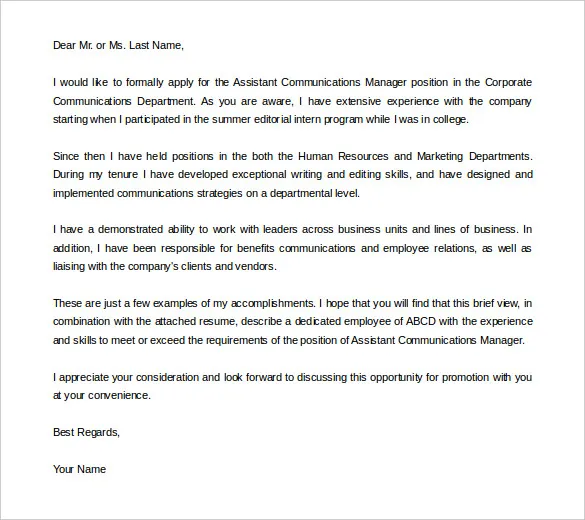
Understanding Promotion Cover Letters
Navigating the professional landscape often involves seeking growth, and a promotion represents a significant step forward. To effectively communicate your aspirations and qualifications for a higher position within your current company, a well-crafted promotion cover letter is essential. This guide provides a comprehensive overview of promotion cover letters, offering insights, examples, and tips to help you create a compelling document that can significantly increase your chances of success. Understanding the nuances of writing a promotion cover letter is critical for showcasing your value and readiness for the next level. This guide will help you understand the importance of a well-structured cover letter.
What is a Promotion Cover Letter
A promotion cover letter is a formal document that you submit to your employer to express your interest in a higher-level position within the company. It’s a strategic tool designed to highlight your accomplishments, demonstrate your readiness for increased responsibilities, and articulate how you can contribute to the company’s success in a new capacity. Unlike a standard job application, this letter is tailored to internal opportunities, acknowledging your existing knowledge of the company culture and operations while emphasizing your growth within it. The primary goal is to persuade your manager or the hiring committee that you are the best candidate for the promotion, showcasing your achievements and future potential.
Why You Need a Promotion Cover Letter

While your performance reviews and internal reputation may speak volumes, a promotion cover letter serves as a concise, persuasive summary of your qualifications. It allows you to strategically highlight specific achievements and skills that align with the requirements of the new role. This is your opportunity to provide context to your past performance, illustrating how your contributions have benefited the company and how they’re relevant to the new position. Additionally, a cover letter demonstrates your proactive approach and genuine interest in the promotion, setting you apart from other potential candidates. It allows you to make a strong case for your promotion. It also offers you an avenue to show your passion for the job.
Key Elements of a Promotion Cover Letter
A well-structured promotion cover letter incorporates several key elements to effectively convey your qualifications and enthusiasm. Each section plays a crucial role in creating a compelling narrative that showcases your suitability for the promotion. From the header to the closing, every component contributes to the overall impact of your letter, and it should be written with care. A strategic approach in each of these aspects will help showcase your skills. Remember to keep it to the point and clear, making sure to avoid any unnecessary jargon.
Header and Contact Information
Begin your cover letter with a professional header that includes your full name, contact information (phone number and email address), and the date. This section ensures that the recipient can easily reach you. It’s a standard practice, but essential for ensuring your application is easily accessible. Ensure the formatting is consistent and matches the professional tone of the letter, reflecting attention to detail. Consider using a professional font and layout to make it easy to read. Double-check all information for accuracy before submitting your letter. See the image below for header example.
Greeting and Addressing the Recipient

Address your letter to the hiring manager or the specific person responsible for making promotion decisions. If possible, find out the name of the individual to personalize your greeting; use ‘Dear Mr./Ms. [Last Name]’ instead of a generic greeting. Addressing the recipient by name demonstrates that you have taken the time to research and tailor your letter. This personal touch immediately captures the reader’s attention, showing respect and initiative. Avoid using generic greetings, and always ensure that you spell the name correctly to show your professional demeanor.
Opening Paragraph
Start with a concise statement of your interest in the promotion, clearly stating the position you are applying for. Briefly mention how long you’ve been with the company and your current role. Immediately highlight your most relevant skills or a significant achievement that aligns with the new role’s requirements. This section sets the tone for the rest of your letter and captures the reader’s interest from the start. The opening paragraph is crucial; it must create an immediate impact, setting the stage for a compelling case for your promotion.
Highlighting Achievements
Dedicate a significant portion of your letter to detailing your key achievements in your current role. Use specific examples to demonstrate your contributions to the company’s success. Quantify your results whenever possible (e.g., ‘Increased sales by 15%’). Focus on achievements that align with the responsibilities of the new position, showcasing how your skills and experience make you an ideal candidate. The goal is to prove that you not only meet the requirements but also have a track record of exceeding expectations. Providing context makes it easy for the reader to understand your success. This method also proves your value and sets you apart from other candidates.
Quantifiable Results

Use data and statistics to quantify your achievements. Instead of saying ‘Improved customer satisfaction,’ state ‘Increased customer satisfaction scores by 20% through the implementation of a new support system.’ Numbers and percentages provide concrete evidence of your impact. Using quantifiable results showcases your ability to deliver tangible outcomes, which is highly valued by employers. The use of hard data makes your claims more credible and impactful. These help to make your letter memorable.
Skills and Qualifications
Outline the skills and qualifications that make you a strong candidate for the promotion. Match these to the requirements listed in the job description. Mention both hard skills (technical abilities) and soft skills (communication, leadership, teamwork). Provide examples of how you have used these skills in your current role and how they will contribute to the new position. This section is where you connect your past performance with the requirements of the new job, demonstrating your readiness to take on additional responsibilities. Tailoring your skills to the job description shows that you understand the needs of the new role. Keep in mind to avoid generic information.
Expressing Enthusiasm and Intent
Convey your enthusiasm for the promotion and your dedication to the company. Express your eagerness to take on new challenges and contribute to the company’s future success. Highlight your understanding of the new role and your vision for how you can excel in it. Your enthusiasm should be genuine and should reflect your commitment to both personal and professional growth. Avoid sounding overly eager, but ensure the reader understands your level of interest and your proactive approach to the promotion. This section should clearly convey your goals and intent.
Closing and Call to Action

Conclude your letter by reiterating your interest in the promotion and thanking the reader for their time and consideration. Include a call to action, such as expressing your availability for an interview or further discussion. Keep the closing brief, professional, and focused on the next steps in the process. A strong closing ensures that the reader remembers your application. Use a polite and confident tone, ensuring the reader understands the next steps. A well-written closing statement reinforces your enthusiasm.
Formatting Your Promotion Cover Letter
The formatting of your promotion cover letter is essential for making a positive first impression. A well-formatted letter is easy to read, professional in appearance, and reflects your attention to detail. Pay close attention to the visual elements, as they significantly impact the overall effectiveness of your letter. A well-structured letter makes it easy for the hiring manager to find the relevant information and assess your qualifications. The layout, font, and spacing are critical for presenting a polished and professional image.
Font and Font Size
Use a professional font, such as Times New Roman, Arial, or Calibri. The font size should be between 10 and 12 points to ensure readability. Avoid overly ornate or casual fonts, as they can detract from the seriousness of your application. Consistency is crucial; maintain the same font throughout the letter. A readable font and size will create a positive impression, making the letter easy on the eyes. Avoid experimenting with uncommon fonts, as these may affect how your letter is presented.
Margins and Spacing

Set standard margins (typically 1 inch on all sides) for a clean look. Use single spacing within paragraphs and double spacing between paragraphs. This creates a balanced and uncluttered layout, making the letter easy to read. Proper spacing makes the letter visually appealing, and it prevents the document from appearing cramped or overwhelming. Proper margins and spacing improve the letter’s overall presentation. See the image below for an example.
Proofreading and Editing
Carefully proofread and edit your cover letter to eliminate any grammatical errors, spelling mistakes, and typos. These errors can damage your credibility. Ensure that the language is clear, concise, and professional. Consider having a colleague or friend review your letter for a second opinion. Thorough proofreading demonstrates attention to detail and professionalism. Before submitting the letter, it’s essential to perform multiple checks, using tools and the help of other professionals to avoid errors. See the image below for an example of proofreading.
Promotion Cover Letter Examples
Reviewing sample promotion cover letters can help you understand how to structure your own. Examples provide a framework for highlighting achievements, skills, and enthusiasm. The following examples are tailored to different roles, offering insights into adapting your letter to various positions. Each example demonstrates a different approach, providing inspiration for your own unique application. When reviewing the examples, pay close attention to how each candidate presents their experience and relates it to the new role’s requirements. Tailoring the examples to your specific situation and role is a key element.
Example 1 Marketing Manager

Dear [Hiring Manager Name],
I am writing to express my keen interest in the Marketing Manager position at [Company Name], as advertised on [Platform]. With five years of experience in marketing, coupled with my proven track record of driving successful campaigns, I am confident I can significantly contribute to your team’s success. In my current role as Senior Marketing Specialist, I spearheaded the [Campaign Name] campaign, which resulted in a 25% increase in lead generation and a 10% rise in sales within the first quarter. I also managed the company’s social media presence, increasing engagement by 30% and expanding our follower base by 40%. My skills encompass digital marketing, content strategy, and team leadership. I am eager to contribute my expertise to drive growth and innovation as a Marketing Manager. I am excited about the opportunity to bring my skills to the marketing department.
Example 2 Senior Developer
Dear [Hiring Manager Name],
I am writing to apply for the Senior Developer position at [Company Name]. As a Lead Developer for the past three years, I have consistently delivered high-quality code and mentored junior developers. During my tenure, I led the development of [Project Name], resulting in a 35% improvement in system performance and a 20% reduction in bug reports. I am proficient in Java, Python, and JavaScript, as well as Agile development methodologies. I am eager to take on a more senior role where I can contribute to the strategic direction of our software development efforts. I believe that I can bring new perspectives and improve the skills of others. My passion for development, combined with my leadership experience, makes me an ideal candidate. I am excited to grow with the company.
Example 3 Project Manager
Dear [Hiring Manager Name],
I am writing to express my interest in the Project Manager position, as advertised internally at [Company Name]. With a solid background in project management, I have successfully delivered multiple projects on time and within budget. As a Project Lead, I managed the [Project Name] project, which resulted in a 15% reduction in project costs and a 20% improvement in team efficiency. I am skilled in project planning, risk management, and stakeholder communication. I am confident in my ability to lead and motivate teams to achieve our strategic goals. I am looking forward to the opportunity to apply my skills and experiences. My proactive and results-oriented approach, combined with my commitment to innovation, will make me a valuable asset. I am certain that I will be an asset for the company.
Tips for Writing a Compelling Promotion Cover Letter

To maximize the impact of your promotion cover letter, consider these additional tips to ensure that your application stands out. These suggestions go beyond basic formatting and content, focusing on strategic elements that enhance your overall presentation. By incorporating these insights, you can further elevate your chances of securing the desired promotion. These tips are crucial for creating an effective and memorable cover letter, helping you to showcase your value and potential to the hiring manager.
Tailoring to the Job and Company
Customize your cover letter for the specific position and the company’s needs. Research the new role’s responsibilities and requirements and demonstrate how your skills and experience align with them. Mention the company’s recent achievements or initiatives that resonate with you, showing that you understand and appreciate the organization’s goals. Tailoring demonstrates that you are genuinely interested and have carefully considered how you can contribute. Generic letters can be quickly dismissed, as they suggest a lack of interest and understanding. Always show your interest by highlighting the company’s accomplishments.
Focusing on Contributions
Emphasize your contributions and the value you have added to the company in your current role. Quantify your achievements using metrics like percentages, numbers, and specific results. Illustrate how your actions have positively impacted the company’s performance. Focus on your achievements and show how you can contribute in the future. It provides concrete evidence of your capabilities and potential for the new role. Always mention your contributions to ensure your letter has a strong impact.
Showing, Don’t Just Telling
Instead of simply stating your skills, provide concrete examples that demonstrate how you have used them. Use the STAR method (Situation, Task, Action, Result) to structure your examples, making them clear and impactful. This approach brings your skills to life, providing the reader with a deeper understanding of your capabilities. Showing, rather than just telling, creates a more compelling narrative, making it easier for the hiring manager to visualize your success. Make your writing memorable and effective.
Common Mistakes to Avoid
Certain mistakes can undermine the effectiveness of your promotion cover letter. Being aware of these common pitfalls will help you avoid them, ensuring that your application is polished and professional. By avoiding these mistakes, you significantly improve your chances of making a positive impression and securing the promotion. It is essential to be proactive in reviewing your letter to check for mistakes.
Generic Letters
Avoid using a generic cover letter that is not tailored to the specific position or company. Such letters appear impersonal and demonstrate a lack of genuine interest. Always customize your cover letter to showcase your understanding of the new role and your commitment to the company. These types of letters do not provide concrete examples or results. Generic letters fail to capture the reader’s attention. Customization is essential for a strong application.
Ignoring the Instructions
Carefully review any instructions provided by the company or hiring manager and adhere to them. Ignoring these instructions suggests that you are not detail-oriented. Following the instructions is a clear indicator of your ability to follow directions. When applying, pay close attention to all details. Failing to meet the requirements can lead to your application being immediately rejected. Always check to ensure you followed all the rules, as listed in the job description.
Lack of Proofreading
Always proofread your cover letter thoroughly to eliminate any errors in grammar, spelling, or punctuation. Mistakes can damage your credibility and make you appear unprofessional. Proofreading is a critical step in the writing process. Take the time to review your cover letter multiple times and consider using a grammar checker. Make sure you have edited all errors.
Conclusion
Writing a promotion cover letter is a crucial step in advancing your career within your current company. By understanding the key elements, utilizing examples, and avoiding common mistakes, you can create a compelling letter that showcases your qualifications and increases your chances of securing the promotion. Tailor your letter to the specific position and the company’s needs, highlighting your accomplishments, skills, and enthusiasm. Through careful planning, strategic writing, and attention to detail, you can create a compelling cover letter that effectively presents your candidacy for the promotion. Remember to proofread your work carefully before submitting your cover letter. With careful consideration of all elements, you can build a strong case for your promotion.